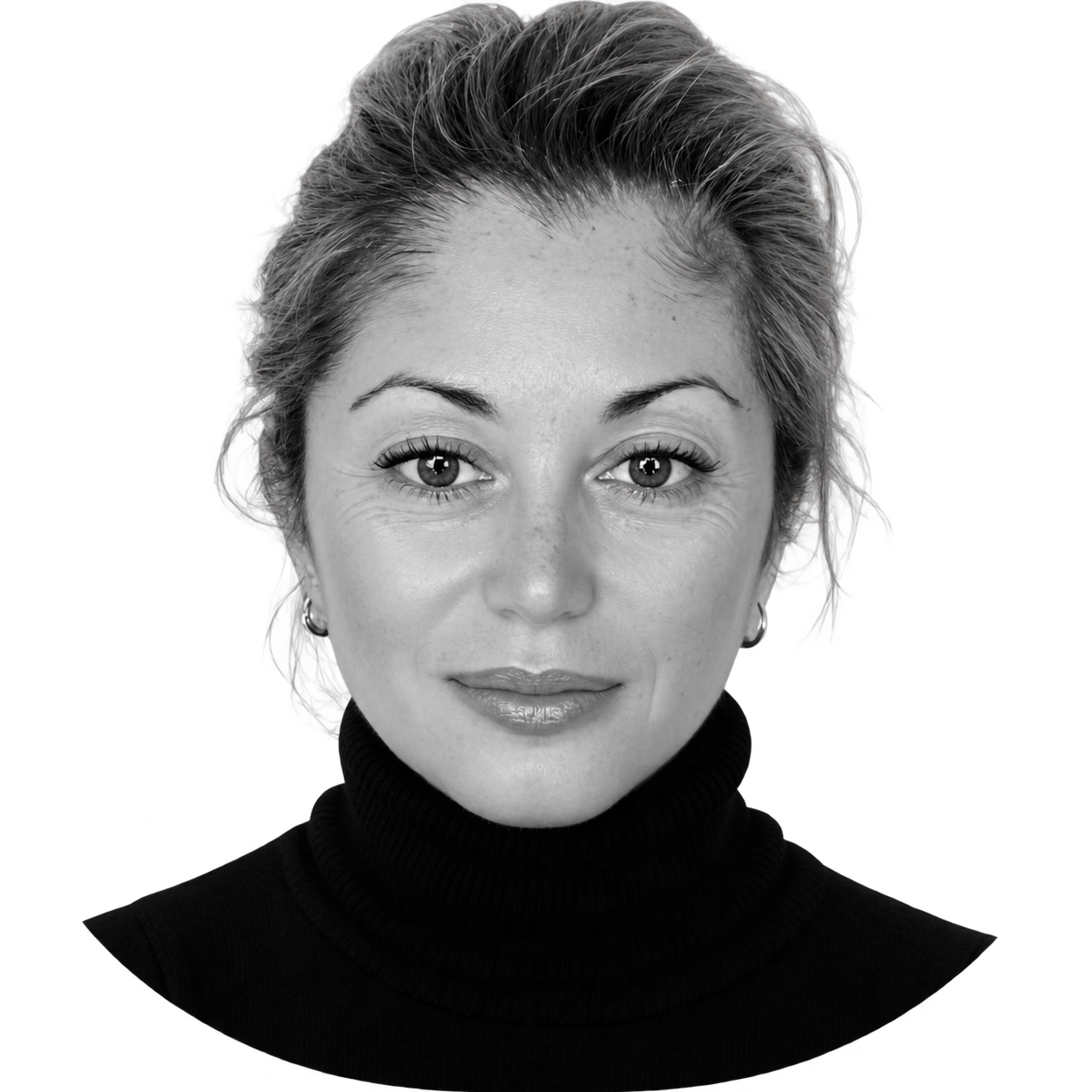
invisible woman
THE ANATOMY OF A LABEL
How Relationships Became a Security Story — and Why I Ended Up Carrying the Labels
A month after the headlines
A month ago, I became an international news story.
On 14 September 2026, The Telegraph broke a story involving a British woman, a Spanish naval officer, a relationship that began on Tinder, and allegations of Russian espionage connected to NATO's military headquarters at Northwood.
The Times followed. Then came Spanish and international coverage, including El Español and El Mundo.
It had everything a sensational story could possibly need.
A woman born in the Soviet Union. A handsome Spanish naval officer. A passionate relationship. NATO. A shooting range. Security concerns.
And, inevitably (why?), the suggestion of a Russian spy.
The woman was me.
What made the experience particulary extraordinary was that, until then, I had maintained an almost invisible public existence.
I had a half-dead LinkedIn account, virtually no other social media presence and no particular interest in making my private life public.
Indeed, one of the peculiar features of the institutional controversy surrounding me was how little information about me appeared to be publicly available.
I was a solicitor. A mother. A partner.
Not exactly the material of an international espionage thriller.
Yet somehow, that was the character being written for me.
The publicity I never intended
I had approached the press for a practical reason.
I was preparing to travel to Russia, and after more than a year of disputes involving military and government authorities, I believed that some public visibility could provide a measure of personal protection, as the approached institutions, which caused that "inconvenience" refused to explain me the risks they have created in a first place.
The newspapers, understandably, saw a story. A sensation.
What followed was a wave of attention that compressed an extremely complicated personal and institutional history into a handful of irresistible elements.
Tinder.
Seasoned with Russian origins.
Wrapped in NATO secrecy.
Enhanced by the presence of a Spanish naval officer.
Spiced up with a woman who knew how to shoot.
And served to the public as an espionage scandal.
I could have retreated.
I could have hidden from the headlines, refused interviews and waited for the attention to disappear.
Instead, I decided to do something rather different.
I would not allow the media to become yet another institution defining me without my participation.
I engaged with journalists.
Where I believed details were inaccurate, I corrected them. Publicly. Where context was missing, I supplied it. Publicly. Where I could distinguish a documented fact from a rumour or interpretation, I did so. Publicly.
And then I made another decision.
If people were going to tell stories about me, perhaps it was time I began telling my own.
I started publishing on LinkedIn. People involved did not like it. When that publishing space was removed, I moved the project to my own website.
Today, Invisible Woman has its own home, its own growing narrative and its own documentary architecture.
The initial media frenzy has subsided, but my conversations with journalists have not ended.
Some of those discussions have become slower, more investigative and more interested in what can actually be established.
They have their questions.
I have mine.
We are, in a sense, digging the same tunnel from opposite ends.
And during this month, while revisiting the documents and reconstructing the events, I realised that I had been looking at my own story from the wrong angle.
I had thought I was fighting institutions.
But the deeper story was something else.
I was a woman trying to reclaim the right to be described by what I actually did — rather than by the identities other people found convenient to give me.
1. The Man Had a Relationship. The Woman Became a Character.
A week after the first newspaper publication, I received a WhatsApp message from my (ex) shooting instructor.
“I see you’re famous now... or should I say notorious? 😈”
Then came the inevitable suggestion:
“Channel 4 documentary next?”
I laughed.
A few minutes later, he added:
“I thought providing them with the Putin picture was a gangster move 👊🏽”
Apparently, the photograph had made an impression.
I replied that I also had a picture with a cardboard Chinese leader, but the journalists hadn't wanted that one.
It was a perfectly ordinary conversation between two people who knew each other before one of them unexpectedly became an international news story.
And yet, looking at it now, I find it rather revealing.
Famous or notorious?
The distinction was offered as a joke. But it captured something important about what had happened to me.
A week earlier, I had been a woman with a complicated personal history, an ongoing legal dispute and some unusual photographs.
Now, I was becoming a character.
The photographs hadn't changed.
My shooting skills hadn't changed (maybe deteriorated without a year training).
My place of birth hadn't changed.
My relationship with a Spanish naval officer hadn't changed (hm, almost, I ultimately blocked him after a month he has reappeared in my life again, in this respect yes, we can call it constant).
What had changed was the story told around those facts.
A photograph with a political leader on a cardboard could become a suspicious association. In a primary school.
Shooting lessons could become a sign of something more sinister. Such as that the woman can hold her breath for two seconds.
A romantic relationship could become the opening scene of an espionage thriller. Somewhere in Hollywood.
And the woman at the centre of it all could become notorious without having done anything new.
That was when I began thinking about the difference between an event and the identity constructed around it.
Because there were two people in that relationship.
A man and a woman.
The man was Commander Laureano Pastor Veiga, a Spanish naval officer serving within NATO's military structure.
He had a professional identity, a rank, responsibilities and a career. His relationship became the subject of serious institutional decisions, with significant consequences for him.
But look at the language that developed around me.
Fucking Russian Spy.
Red Sparrow.
Unwelcome Partner.
Trespasser.
Parasitic.
Increasingly Vexatious.
I have not found an equivalent collection of sexualised or nationality-based descriptions of my male partner in the material I have examined.
He was discussed primarily as an officer whose relationship had created a professional and administrative problem.
I was increasingly discussed as a particular kind of woman.
And this is where the story becomes interesting from a woman's perspective.
Why did the woman's identity require so much explanation by the institutions, which initial made decisions about her and when she asked about how these decisions were made, proceeded with more labels?
What was so remarkable about a British woman with Eastern European roots falling in love with a Spanish naval officer?
I was not definitely unique. There was at least another woman of the same roots married to another Spanish officer, who actually took active part in a group hunt after me.
Why could her nationality, her attractiveness, her ability to shoot and her habit of asking questions be assembled into the image of a female Russian intelligence operative?
Consider the counterfactual.
Imagine a British man born in the Soviet Union.
He meets a Spanish female naval officer on Tinder.
They fall in love.
He enjoys shooting.
He has photographs with politicians printed on cardboard.
He asks questions.
Would somebody have reached quite so instinctively for the archetype of a sexually dangerous foreign spy?
Perhaps there would have been security questions. Perhaps his background would have attracted scrutiny.
But Red Sparrow is not a gender-neutral expression.
It belongs to a particular cultural imagination: the attractive, intelligent, sexually persuasive Eastern European woman whose intimacy with a man in a position of power must conceal an ulterior motive.
The man had a relationship. The woman became a character.
And once the character existed, more ordinary things about me could be interpreted through it.
My small talk manners became suspicious curiosity.
My independence became an unwillingness to cooperate.
My legal questions became vexatious behaviour.
My refusal to accept an unexplained decision became evidence that I was troublesome.
I am not suggesting that every institution involved believed I was a spy, or that every disputed administrative decision resulted from sexism. I am stating that the institutions knew about "Russian spy" rumours and did nothing about stopping them. This is in their own pleaded accounts. One of my question - why? Is it a standard or oversight?
And the gendered character of the language is itself worth examining.
My ex-partner's professional consequences were real. The identities attributed to me were a separate phenomenon.
Both deserve investigation, but they should not be confused.
I am not asking to be protected from criticism because I am a woman.
I am asking why criticism of my conduct so readily expanded into interpretations of my identity.
There is a difference between saying that a woman did something wrong and deciding what sort of woman she must be.
The first proposition can be tested against evidence.
The second can become almost impossible to escape.
That is the danger of a label.
And that is why, when my shooting instructor asked whether I was famous or notorious, the joke stayed with me.
Not because he had accused me of anything.
Quite the opposite. His message was affectionate, teasing and entirely recognisable as the sort of humour people share with somebody they know.
But it revealed how quickly a public narrative can change the meaning of a person.
A week earlier, I was simply his former shooting student.
Now I was the woman from the NATO spy headlines.
Same woman.
Same photographs.
Same ability to shoot.
Different story.
And I had decided that, this time, I would not allow the story to become my identity without examining how it had been constructed.
I asked myself a question.
When a woman's presence becomes inconvenient to an institution, does the institution examine what she has actually done — or begin constructing an explanation of what kind of woman she must be?
I am asking whether the language and assumptions applied to me followed recognisable gendered patterns.
Because Red Sparrow is not a neutral occupational description.
It is an archetype.
And it is not an archetype that would naturally have been attached to my male partner in the same circumstances.
2. The Difference Between Being a Woman and Being Someone's Version of a Woman
I identify myself as a woman.
I am a mother.
I am a partner.
I am a solicitor, an AI practitioner, a creator and an author.
These are descriptions connected to my identity, relationships, qualifications and activities.
I can explain what I mean by them.
My professional qualifications can be verified. My creative work can be examined. My past and current family relationships are facts of my life.
Of course, other people may disagree with my opinions, question my professional conclusions or disapprove of my personal choices.
That is entirely legitimate.
But there is a difference between questioning a person's actions and assigning them a character.
She is a solicitor describes a professional status.
She made a complaint describes an action.
She was born in Leningrad describes a historical fact.
She is a Russian spy is an assertion about hidden identity, allegiance and conduct.
It attributes to a woman a concealed identity, hostile allegiance and involvement in espionage.
Such an allegation cannot be justified by her birthplace, her romantic relationship, her appearance or her ability to shoot.
It requires evidence.
And when an allegation of that gravity circulates within institutions exercising public authority, the question is no longer simply what people said about a woman. It is whether an unsubstantiated accusation was allowed to influence how she was treated.
And yet the history of women's representation is full of examples in which an image of the woman replaces an examination of what the woman has actually done.
The seductress.
The manipulator.
The hysterical woman.
The dangerous foreign woman.
The troublemaker.
The woman who must accept unwanted demands.
The woman who asks too many questions.
The woman who should shut up and listen.
The woman who should know her place.
The woman who must not have her own thoughts or will.
The woman who must accept the men's desires.
These archetypes are powerful precisely because they are immediately recognisable.
They do not require much explanation.
The audience already knows the story.
But recognisability is not evidence.
A familiar character is not necessarily a real person.
That is the distinction I now want to examine across the five institutional strands of my experience.
3. When Does a Description Become a Label?
Institutions necessarily classify people. This is how they operate.
Police must record incidents and identify the legal status of those involved.
Military authorities must assess security matters.
Complaint investigators must evaluate competing accounts.
Government lawyers must explain and defend decisions.
An institution is not doing something improper merely because it describes a person's behaviour or legal position.
Indeed, the ability to reach reasoned conclusions is central to lawful administration.
The problem begins when the description stops being a conclusion from evidence and starts functioning as a substitute for evidence.
For this investigation, I define a label as:
A characteristic attributed to a person that comes to operate as an independent explanation of their identity, behaviour, intentions or status, without its factual foundation being adequately established, tested or kept under review.
A label is not necessarily false.
That is important.
If somebody demonstrates that I behaved dishonestly, the evidence must be examined.
If somebody identifies a particular offence I committed, its legal elements and the alleged conduct must be examined.
If a military authority says that my relationship created a legitimate security concern, I am entitled to ask what that concern was, how it was assessed and what consequences could lawfully follow.
My objection is not to being assessed.
My objection is to being characterised without an adequate explanation of the assessment.
Five mechanisms of labelling
These categories can overlap.
A description can begin as an accurate fact and develop into a stereotype.
An administrative classification can become an assumption about character.
A complaint-handling term can become a reason not to engage with further complaints.
And a stereotype about a woman can become particularly consequential when it enters an institutional record.
Eight questions every label must answer
For each characterisation, I propose an eight-part forensic test.
Origin: Who used it first?
Evidence: What facts supported it?
Authority: Was the person or institution entitled to make that determination?
Meaning: What did the words actually mean in context?
Transmission: How were they recorded, repeated or passed onwards?
Effect: What consequences, if any, followed?
Correction: What happened when the description was challenged?
Institutional function: Why was the characterisation useful, and why did it persist?
The last question may be the most revealing.
Sometimes a label identifies a genuine risk. In IT world we call it "tags". Tags are extremely important we you design the architecture of data management and security.
Tags make administration and management possible.
Sometimes a tag supplies a justification for an earlier decision.
Sometimes it may preserve an institution's existing interpretation of events.
And sometimes it may have no material influence at all.
I am interested in establishing which mechanism operated in each instance.
4. Hertfordshire Police: From a Woman on a Bench to an Alleged Offender
On 26 August 2025, I was at the Visitor Centre of the Northwood military establishment.
I had been refused entry.
I remained outside, sitting on a bench.
RAF Police and Hertfordshire Police became involved, and I was eventually escorted to the public road.
I was not arrested.
Nevertheless, the language subsequently used in connection with the incident raises questions about the way I was understood.
“Offender” label
In the records and correspondence surrounding the incident, language was used connecting alleged non-compliance with the occurrence of an offence.
Since August 2025 I have repeatedly asked a rather ordinary question.
What offence?
And what non-compliance?
Non-compliance with which instruction, legal obligation or statutory provision?
My concern is that, although these questions have been raised repeatedly, the precise basis of the description has not been adequately identified to me.
That does not automatically establish that the police had no lawful concerns.
But it does mean that the characterisation cannot properly be evaluated without its alleged factual and legal foundation.
There is a difference between believing somebody may have committed an offence and establishing that they did.
A woman does not become an offender merely because she is troublesome, persistent or unwilling to accept an unexplained instruction.
“Trespasser” label
The next description concerns trespass.
Again, the factual and legal questions are specific.
Where was I?
What was the status of that location?
What permission applied?
What was I instructed to do?
And what did I actually do?
These questions can be answered through evidence and law.
A military establishment is entitled to maintain appropriate security arrangements.
But the existence of those arrangements does not eliminate the need to examine the circumstances of a particular person's conduct.
I do not object to a lawful conclusion that I was trespassing, if one can be established.
I object to the possibility of being treated as a trespasser without an adequate explanation of why the law applied to my conduct in that way.
“Under Investigation” label
The third characterisation is particularly interesting because it appears to have entered the encounter through information supplied between policing bodies.
Review materials record that RAF Police had communicated information to Hertfordshire Police suggesting that my partner and I were under investigation, with the National Security Act 2023 mentioned in the surrounding context.
The important issue is not whether Hertfordshire Police formally determined that I was a suspect.
It is what its officers were told before assessing the situation.
A woman sitting outside a military Visitor Centre is one thing.
A woman sitting outside the same Visitor Centre who has been described to the responding officers in connection with a national-security investigation may be perceived quite differently.
Was the information accurate?
What investigation was meant?
Who communicated it?
What was its purpose?
Did it affect the officers' actions?
These questions remain significant because a description can influence a decision even when the person making that decision did not originate it.
The gender question
Why do I regard this through the lenses of my gender?
Not because every police decision affecting a woman is necessarily discriminatory.
But because this entire sequence began with my position as the civilian partner of a male military officer.
My male partner had a professional identity defined by rank and service.
I entered the narrative through a personal relationship.
My conduct (and sometimes its the conduct absence) then became connected to descriptions of trespass, possible offending and national-security concerns.
The question is whether my actions were assessed independently or through assumptions already attached to my position as the woman in the relationship.
It is a question, not a predetermined conclusion.
Why this matters beyond August 2025
I have since asked Hertfordshire Police to investigate alleged wrongdoing connected with the wider events.
I am concerned that information previously communicated about me may complicate the independent consideration of those allegations.
If an institution has already received and retained a particular portrayal of a woman, what safeguards ensure that the portrayal does not influence its handling of her later complaints?
There is a potential problem of informational contamination and institutional conflict which warrants examination.
A woman should not need to prove that she is a sympathetic character before her allegations are assessed according to law.
5. SPCC: When a Woman's Words Become Someone Else's Account
The Service Police Complaints Commissioner strand is, in some ways, more troubling to me than the original incident.
Because here the central problem concerns who gets to define the meaning of a woman's own words.
“Liar” label
I complained about the behaviour of a female squadron leader during the Northwood incident.
My account included a statement I attributed to her:
“I don't care if you're British or not, you have no rights here.”
I also asked whether she had been aware of rumours circulating in the military environment that I was a Russian spy.
I raised the possibility of prejudice because I wanted to understand the context of her behaviour.
My account of the alleged remark has remained consistent. It remains consistent. Not a single word changed.
The subsequent institutional material, however, introduced changes or clarifications in the surrounding factual picture.
Earlier accounts indicated that the remark had not been heard by others and that the officer was not aware of the espionage rumour.
Later review material recorded awareness of such a rumour in the military environment.
That does not prove the officer said the words I attributed to her. But the fact that no cameras were working at the apparently most secure military site in the UK, which could have confirmed that I was indeed subject, or rather object, of this discriminatory dehaviour, triggers some questions.
It also raises a legitimate evidential question about how the competing accounts were assessed.
Why was one version preferred?
What evidence supported that preference?
And how were later clarifications incorporated?
There is an important difference between concluding that a complaint cannot be substantiated and concluding that the woman making the complaint is lying.
The first is an evidential outcome.
The second is a judgment about honesty.
“It was a lie”
One episode illustrates the danger particularly clearly.
During the complaint process, I used the expression:
“It was a lie, obviously.”
I was referring to a statement made by another person. A NATO officer who promised to come out and to bring my ex-partner's paperwork and obviously lied about such intention.
The statement was interpreted as though I had admitted that I had lied.
In other words, my allegation about somebody else's truthfulness was turned into an apparent admission of my own dishonesty.
The subsequent review acknowledged a misunderstanding but considered it immaterial to the outcome.
Perhaps the error genuinely made no difference.
But that conclusion requires reasoning.
If an investigator has misunderstood who was accused of lying, the significance of that misunderstanding must be examined in the context of the investigation as a whole.
It is an example of something I find increasingly important:
A woman can speak, yet still lose control over the institutional meaning attributed to her words.
“Dishonest Visitor” label
This is a label I use to describe an implication I perceive in the handling of the complaint, rather than a formal judicial finding.
The question is whether my behaviour as a visitor was characterised accurately.
What was supposedly dishonest?
What information did I provide?
Was it false?
Was any falsehood deliberate?
And did it matter to the events under investigation?
A disagreement, misunderstanding or incorrect assumption does not automatically amount to dishonesty.
If dishonesty is alleged, it requires its own evidential foundation.
Still waiting to hear...
“Misrepresented Complainant” label
This describes my concern about the way my complaint was reconstructed.
I complained about particular conduct and possible prejudice.
I then found myself disputing how those concerns had been described in the investigation and review.
A complaint investigator is entitled to identify issues, assess their relevance and reach conclusions.
But a decision must still address the substance of the complaint.
If the complainant's words are interpreted differently from their original meaning, if the issues are reframed, or if third-party accounts are preferred without sufficient explanation, the review risks evaluating a reconstructed complaint rather than the original one.
That is the methodological question I have raised in my legal challenges.
The woman's dimension
There is a recognisable pattern here that extends far beyond my own dispute.
A woman raises a concern about how she was treated.
Attention shifts to whether her account can be trusted.
Her language is scrutinised.
Her credibility becomes an issue.
And the institution may end up spending more effort defending the quality of its previous investigation than examining the original allegation.
This pattern is not proof that sexism caused the decisions in my case.
But it is a sufficiently familiar risk in complaint handling to warrant careful scrutiny.
The person who complains should not become the problem merely because she insists that the complaint be understood correctly.
6. NATO / MARCOM: The Dangerous Foreign Woman
This is where the gendered character of the story becomes particularly apparent.
I was in a relationship with Commander of the Spanish Navy.
We were two adults in a consensual relationship.
He was an experienced military officer.
I was a civilian solicitor. I am a citizen of two NATO countries. I live in the West for the last 35 years.
And yet, as the relationship became controversial, it was my identity that became particularly vulnerable to transformation.
“Russian Spy” label
I was born in the Soviet Union.
This is the fact of my biography. It is in my both British and Polish passports.
But in a military environment concerned with security, a woman's origin, combined with some sexual dreams can acquire an entirely different narrative function.
The later record contains references to rumours portraying me as a Russian spy.
The precise origin of those rumours and their relationship to official decisions remain questions I am investigating.
In fact, I think when Putin received a report about a "Russian spy at MARCOM", he put a question mark against my name, rather than a tick (which would explain my conversation with an intelligence officer in August 2026).
I think that the first line in any espionage manual is "Make sure that there is no association with your origin as being from a hostile country".
I was always shocked (and I am still is) how little professionalism showed NATO, British and Spanish agencies.
The important gendered issue is also the character the rumours created.
Would the same combination of nationality, attractiveness, curiosity and a romantic relationship have produced the same fictional character if the civilian had been a man? Somehow, I think that if in December 2024 a Polish guy born in the USSR called Jan were invited to Spanish NATO event or Christmas dinner by a female Spanish officer called Laura, he would land up drinking beer with Spanish command officer after 10 minutes of so, since having entered the room.
I cannot prove a counterfactual.
But the cultural stereotype is plainly gendered.
Also, if we recall the scene from the "Red Sparrow" movie, the male Russian spy did not perform well in public...
“Unwelcome Partner” label
The second label concerns my position within the officer's personal and professional world.
Security and disclosure rules may legitimately apply to military relationships.
That is not the issue.
The question is whether I was treated as an independent civilian with a distinct legal position or primarily as an inconvenient extension of my partner.
This distinction matters particularly for women.
Historically, a woman's public and legal identity was often understood through her relationship to a man.
Wife.
Mistress.
Partner.
Dependent.
Influence.
A person whose significance came from the man to whom she was attached.
My concern is that something of that logic may have operated here.
My partner had a military career, duties and a defined institutional position.
I had my own citizenship, profession, history and rights.
Those identities did not merge simply because we loved each other.
A woman does not become an accessory to a man's institutional status by entering a relationship with him.
“Excluded Legal Representative” label
As the dispute developed, I began applying my legal knowledge to the circumstances.
This introduced another identity that sat uneasily with the original portrayal of me.
I was not merely somebody's partner.
I was a qualified solicitor capable of understanding procedures, interpreting documents and questioning decisions.
The distinction between physical access to military premises and legal representation or assistance became important.
A military authority may regulate who enters a secure establishment.
But questions about legal assistance, communication and participation require their own procedural analysis.
My concern is whether the restrictions affecting me as a civilian were allowed to obscure or diminish my separate professional role.
There is a broader feminist question here.
What happens when a woman whom an institution has understood primarily as somebody's girlfriend begins speaking and acting as a lawyer?
Is her professional competence recognised?
Or does her insistence on examining the rules become another reason to regard her as troublesome?
The available documents must answer what happened in this specific case.
But the question deserves to be asked.
7. The British Ministry of Defence: When a Woman Becomes Derivative
The British Ministry of Defence's formal litigation position offers three particularly revealing descriptions.
Each raises a different question about the relationship between fact, law and institutional interpretation.
“Parasitic” label
In its Summary Grounds of Resistance of 13 November 2025, the Ministry described my access position as parasitic upon that of my partner.
There can be a legitimate legal meaning to this expression.
A claim may depend on another claim. A right may derive from another person's permission or position.
But the legal accuracy of that proposition must be established.
The Ministry has acknowledged that I lawfully entered Northwood in December 2024 as a sponsored visitor.
The issue is therefore not whether my access was connected to a sponsoring arrangement.
It is what legal consequences followed from that arrangement at the relevant times.
What precisely was dependent?
Upon whom?
Under which rule?
And how did the asserted dependency justify the decisions affecting me?
The significance lies in the language of dependency itself.
For generations, women have been defined through relationships to men.
My legal position as a civilian should not be treated as inherently less worthy of independent explanation merely because my presence arose in the context of a relationship.
If parasitic is used as a technical description of a particular legal dependency, its accuracy can be tested.
If it begins to function as a broader characterisation of me as a person, something else is happening.
I was a woman in a relationship. I was not an appendage of the man I loved.
The MoD failed to establish that any administrative status was present to justify the legal meaning of the word "parasitic", yet in their defence they still use it as justification of my treatment.
“Born in Russia” label
My birthplace is a fact.
It cannot meaningfully be disputed.
But the meaning attached to that fact is another matter.
In paragraph 39 of its Summary Grounds of Resistance, the Ministry referred to my place of birth among relevant factors concerning a security investigation. Since June 2025 they failed to identify a single policy, where a place of birth could be a relevant factor of making a restrictive decision against an individual.
A fact may be relevant to an assessment without determining its outcome.
But relevance must have a defined purpose and rational connection to the decision being made.
Being born in Russia is not evidence, by itself, of wrongdoing.
Nor does it establish political allegiance or hidden motives.
For women from Eastern Europe, the issue can become particularly complicated when origin is combined with sexualised cultural stereotypes.
A woman may be judged not only through where she comes from, but through what that origin is imagined to imply about her relationships with men.
That is the danger I want to examine.
The fact itself is true.
The story constructed around it may not be.
“Increasingly Vexatious” label
This is the label that interests me most in relation to what happened after I began challenging the original decisions.
Over the following months, I repeatedly sought explanations, submitted complaints, requested information and pursued legal avenues.
That correspondence may have been demanding.
Some communications may have required significant institutional resources.
But repetition alone does not determine vexatiousness.
The relevant questions concern the circumstances, the applicable rules, the content of the correspondence and the proportionality of the institutional response.
My concern is whether the characterisation began to serve a second purpose: turning my continued attempts to obtain answers into evidence that I was the problem.
This is a familiar dilemma for women who challenge authority.
Be quiet, and your concerns may disappear.
Persist, and you risk being characterised as unreasonable.
Ask questions, and you become difficult.
Demand reasons, and you become vexatious.
I do not claim that every institutional use of the term is illegitimate.
I ask whether its use in my case was adequately justified and whether it influenced the treatment of questions that remained unresolved.
The institutional function
The larger question is how the Ministry became involved in decisions connected with my partner's position within NATO and the Spanish military hierarchy.
I have documentary questions about the communications between the authorities, the origins of the restrictions affecting me and the relationship between the British and Spanish explanations.
These matters are subject to legal proceedings and remain disputed.
But they lead back to the same central issue.
Did officials make decisions based on established facts about my conduct?
Or did assumptions about my identity and relationship acquire a significance that was never adequately tested?
8. Spain: From Red Sparrow to the Woman Who Would Not Behave
I have left the Spanish dimension until last because it contains the clearest cultural archetypes.
And because, frankly, it is difficult to imagine a more revealing intersection of gender, nationality, sexuality and institutional hierarchy.
“Red Sparrow” — Gorrión Rojo label
In September 2026, Spanish reporting described a nickname allegedly used by colleagues in the NATO environment.
Gorrión Rojo.
Red Sparrow.
The reported explanation was that the nickname emerged jokingly from a combination of my Russian background, accent, ability at a shooting range and habit of asking questions.
A joke, apparently.
Now consider what those ordinary facts actually demonstrate.
I was born in the Soviet Union.
I speak several languages.
I can shoot.
I ask questions.
I had fallen in love with a Spanish naval officer.
None of those facts establishes espionage. None of this facts establish that I was freely available for Spanish officer's pleasures and to become subject of their sexual fantasies. By the way, neither Spanish Ministry of Defence or NATO response to my complaints about this fact or established the roots for such treatment.
But place these sexual fantasies and jokes together inside a familiar cultural narrative, and suddenly the woman has become a character.
A foreign woman.
Attractive.
Sexually involved with a military man.
Competent with weapons.
Curious about her surroundings.
Red Sparrow.
The reference is to an espionage story built around a female Russian operative whose sexuality and intelligence are central to her character.
Now imagine the same situation the other way around - Jan and Laura. Can you imagine? I do not think so.
That is why the word matters.
Not because every person who repeated it necessarily believed I was a spy.
But because the joke itself depends on a pre-existing cultural script about women.
Who called whom a spy?
A Spanish article suggested that nobody apart from me or The Telegraph had called me a spy.
But when The Telegraph asked about the accusation, I denied being a Russian spy. The Spanish journalist did not even read the original article.
That distinction is important.
Answering an allegation is not inventing it.
Rejecting a label is not adopting it.
And trying to correct a story about oneself is not evidence that the story originated with oneself.
The precise history of the nickname and the surrounding comments remains something to reconstruct.
But I will not accept the proposition that my public denial somehow makes me responsible for the accusation.
“Puta Espía Rusa” label
Another expression associated with the Spanish narrative is more openly sexualised.
If the reported attribution and context can be established, it raises questions beyond national-security language.
It combines an allegation of espionage with sexual degradation.
The woman is not merely suspected of misconduct.
Her sexuality becomes part of the accusation.
The suggestion is that her relationship with a man may itself be evidence of ulterior motives.
That is a powerful and familiar stereotype.
It is also one that has historically been used to diminish women's agency.
A woman who chooses a relationship is recast as a woman who manipulates.
A woman who is desired becomes dangerous because she is desired.
A woman who refuses to accept somebody else's control becomes a threat.
These are cultural mechanisms, not established findings about the motives of any identifiable officer in my case.
But where such language appears, the mechanism deserves investigation.
“Esta Señorita” label
Then there is the phrase esta señorita.
On its own, it can be perfectly ordinary Spanish.
Its meaning depends on context, tone and speaker.
But consider the potential institutional dynamic when a senior male officer refers to an adult professional woman primarily as this young lady in a dispute about her partner's conduct or position.
The question is whether the expression is simply a conventional form of reference or whether it reflects a diminished recognition of her independent standing.
That cannot be answered from the words alone.
But it belongs within a wider analysis of how the woman was positioned in the language of the military hierarchy.
The man and the woman
This brings me back to the contrast with which I began.
My partner was an officer.
His institutional identity was established through rank, service and professional obligations.
He experienced serious consequences.
But the descriptions directed towards me appear to have drawn upon a different repertoire.
The foreign woman.
The dangerous partner.
The possible spy.
The sexually suspect woman.
The troublesome civilian.
The professional woman who would not accept the institution's explanation.
I have not yet found a comparable set of sexualised archetypes applied to my male partner in the examined material.
That asymmetry does not, by itself, prove discriminatory intent or establish legal liability.
But it is central to understanding how the story was told.
The institutions were dealing with a relationship between two adults. Yet the woman became the character who needed explaining.
9. My Litigation Is Not a Refusal to Be Judged
I have initiated several legal proceedings arising from different aspects of these events.
Each has its own defendants, legal issues and procedural history.
They are not interchangeable.
But they share a broader intellectual question.
How did particular descriptions of me arise, and did those descriptions affect actions taken in relation to me?
Some proceedings concern administrative decisions.
Others concern complaint handling, equality issues and personal information.
None automatically establishes that a particular description was discriminatory or unlawful.
And not every unpleasant or inaccurate statement gives rise to a legal remedy.
But the proceedings provide formal routes for testing specific decisions, records and obligations.
I do not need a court to confirm that I am a good woman.
I am not litigating to obtain a certificate of personal virtue.
I am asking whether institutions acted lawfully, whether their factual premises were sound and whether they met the duties applicable to them.
If evidence establishes that I behaved dishonestly, I will have to confront that evidence. If I can, as I have done nothing wrong.
If it establishes wrongdoing, the relevant legal consequences can be assessed.
If it establishes that particular institutional concerns were justified, those concerns deserve proper consideration.
But the reasoning must be open to examination and cannot be refused only because I am a woman who dared ton bring such a challenge.
Accountability does not mean that an institution must agree with me. It means that its conclusions must be capable of being explained and tested.
And the same standard applies to my own account.
10. Why Women Must Be Allowed to Change
There is another dimension to this story.
At the beginning, I was a woman in love.
That was not my entire identity, but it was the part of my life that brought me into this controversy.
I did not enter the relationship intending to investigate NATO.
I did not fall in love because I wanted to become involved in litigation against government institutions.
I did not imagine that, approaching fifty, I would begin creating music, studying artificial intelligence in depth and writing a book about my own life.
Those developments came later.
They came as responses to circumstances I had never anticipated.
As the disputes became more complicated, I began developing AI-assisted methods of organising information and examining legal and institutional processes.
As the emotional pressures intensified, I found expression through music and dramatic monologues.
When my private life became international news, I began writing.
Each new challenge required something new of me.
Some of those challenges were painful.
Some exposed limitations in my existing knowledge.
Some forced me to reconsider assumptions I had carried for years.
But none of them required me to remain the woman I had been when the story began.
And that is what makes the labels so frustrating. That is why I will not accept them as labels and I will not allow new ones to appear and to get attached to me.
A label attempts to stabilise a person for the sake of the institution.
It assigns a recognisable character and encourages other people to interpret future behaviour through that character.
But people are not static.
Women are not static.
A woman can be a mother, a lover, a professional, an artist and a person engaged in legal proceedings without those roles cancelling one another out.
She can change her mind.
She can acquire new skills.
She can leave a relationship.
She can become more independent.
She can refuse to accept somebody else's interpretation of her.
We, women, did this in the past. A "no" means "no". We did this with the rape cases. It was a long journey, which started with a statutory right of a man to rape his own wife.
And saying "no" doe not automatically makes me dishonest, dangerous or unreasonable.
I do not want to be protected from scrutiny because I am a woman. I want my actions to be scrutinised without being replaced by an archetype of the woman someone thinks I must be.
11. The Question Beneath the Headlines
For more than a year, I asked what the institutions had done to me.
Why had access been restricted?
Why were particular statements made?
Why were complaints rejected?
Why did different institutional accounts appear to conflict?
Those questions remain important.
But a month after the headlines, I have come to understand that there is a deeper question.
How did these institutions come to describe me in ways that made their subsequent actions appear justified?
And how much of that descriptive process depended on what I had actually done, rather than on what others assumed about a woman with my origins, relationships and behaviour?
Perhaps some of the descriptions were reasonable.
Perhaps some were mistakes.
Perhaps others began as jokes, assumptions or rumours.
Perhaps certain words were used to explain decisions already made.
Perhaps some had no meaningful effect at all.
I intend to find out.
And I intend to apply the same discipline to every hypothesis.
Who used the words?
What did they mean?
What evidence supported them?
How did they travel?
What consequences followed?
Were errors corrected?
And what institutional purpose did the descriptions ultimately serve?
There is an uncomfortable question for me, too.
How did I allow so much of this to develop before recognising the pattern?
The answer, I suspect, involves fragmented information, misplaced confidence that institutions would explain themselves, and the fact that I was concentrating on the immediate consequences rather than on the descriptions underlying them.
I did not initially understand how extensively my identity might be contested in official and unofficial narratives.
Now I do.
And I no longer intend to leave that narrative uncontested.
And today's song SOBERANA
A month ago, I became an international news story.
On 14 September 2026, The Telegraph broke a story involving a British woman, a Spanish naval officer, a relationship that began on Tinder, and allegations of Russian espionage connected to NATO's military headquarters at Northwood.
The Times followed. Then came Spanish and international coverage, including El Español and El Mundo.
It had everything a sensational story could possibly need.
A woman born in the Soviet Union. A handsome Spanish naval officer. A passionate relationship. NATO. A shooting range. Security concerns.
And, inevitably (why?), the suggestion of a Russian spy.
The woman was me.
What made the experience particulary extraordinary was that, until then, I had maintained an almost invisible public existence.
I had a half-dead LinkedIn account, virtually no other social media presence and no particular interest in making my private life public.
Indeed, one of the peculiar features of the institutional controversy surrounding me was how little information about me appeared to be publicly available.
I was a solicitor. A mother. A partner.
Not exactly the material of an international espionage thriller.
Yet somehow, that was the character being written for me.
The publicity I never intended
I had approached the press for a practical reason.
I was preparing to travel to Russia, and after more than a year of disputes involving military and government authorities, I believed that some public visibility could provide a measure of personal protection, as the approached institutions, which caused that "inconvenience" refused to explain me the risks they have created in a first place.
The newspapers, understandably, saw a story. A sensation.
What followed was a wave of attention that compressed an extremely complicated personal and institutional history into a handful of irresistible elements.
Tinder.
Seasoned with Russian origins.
Wrapped in NATO secrecy.
Enhanced by the presence of a Spanish naval officer.
Spiced up with a woman who knew how to shoot.
And served to the public as an espionage scandal.
I could have retreated.
I could have hidden from the headlines, refused interviews and waited for the attention to disappear.
Instead, I decided to do something rather different.
I would not allow the media to become yet another institution defining me without my participation.
I engaged with journalists.
Where I believed details were inaccurate, I corrected them. Publicly. Where context was missing, I supplied it. Publicly. Where I could distinguish a documented fact from a rumour or interpretation, I did so. Publicly.
And then I made another decision.
If people were going to tell stories about me, perhaps it was time I began telling my own.
I started publishing on LinkedIn. People involved did not like it. When that publishing space was removed, I moved the project to my own website.
Today, Invisible Woman has its own home, its own growing narrative and its own documentary architecture.
The initial media frenzy has subsided, but my conversations with journalists have not ended.
Some of those discussions have become slower, more investigative and more interested in what can actually be established.
They have their questions.
I have mine.
We are, in a sense, digging the same tunnel from opposite ends.
And during this month, while revisiting the documents and reconstructing the events, I realised that I had been looking at my own story from the wrong angle.
I had thought I was fighting institutions.
But the deeper story was something else.
I was a woman trying to reclaim the right to be described by what I actually did — rather than by the identities other people found convenient to give me.
1. The Man Had a Relationship. The Woman Became a Character.
A week after the first newspaper publication, I received a WhatsApp message from my (ex) shooting instructor.
“I see you’re famous now... or should I say notorious? 😈”
Then came the inevitable suggestion:
“Channel 4 documentary next?”
I laughed.
A few minutes later, he added:
“I thought providing them with the Putin picture was a gangster move 👊🏽”
Apparently, the photograph had made an impression.
I replied that I also had a picture with a cardboard Chinese leader, but the journalists hadn't wanted that one.
It was a perfectly ordinary conversation between two people who knew each other before one of them unexpectedly became an international news story.
And yet, looking at it now, I find it rather revealing.
Famous or notorious?
The distinction was offered as a joke. But it captured something important about what had happened to me.
A week earlier, I had been a woman with a complicated personal history, an ongoing legal dispute and some unusual photographs.
Now, I was becoming a character.
The photographs hadn't changed.
My shooting skills hadn't changed (maybe deteriorated without a year training).
My place of birth hadn't changed.
My relationship with a Spanish naval officer hadn't changed (hm, almost, I ultimately blocked him after a month he has reappeared in my life again, in this respect yes, we can call it constant).
What had changed was the story told around those facts.
A photograph with a political leader on a cardboard could become a suspicious association. In a primary school.
Shooting lessons could become a sign of something more sinister. Such as that the woman can hold her breath for two seconds.
A romantic relationship could become the opening scene of an espionage thriller. Somewhere in Hollywood.
And the woman at the centre of it all could become notorious without having done anything new.
That was when I began thinking about the difference between an event and the identity constructed around it.
Because there were two people in that relationship.
A man and a woman.
The man was Commander Laureano Pastor Veiga, a Spanish naval officer serving within NATO's military structure.
He had a professional identity, a rank, responsibilities and a career. His relationship became the subject of serious institutional decisions, with significant consequences for him.
But look at the language that developed around me.
Fucking Russian Spy.
Red Sparrow.
Unwelcome Partner.
Trespasser.
Parasitic.
Increasingly Vexatious.
I have not found an equivalent collection of sexualised or nationality-based descriptions of my male partner in the material I have examined.
He was discussed primarily as an officer whose relationship had created a professional and administrative problem.
I was increasingly discussed as a particular kind of woman.
And this is where the story becomes interesting from a woman's perspective.
Why did the woman's identity require so much explanation by the institutions, which initial made decisions about her and when she asked about how these decisions were made, proceeded with more labels?
What was so remarkable about a British woman with Eastern European roots falling in love with a Spanish naval officer?
I was not definitely unique. There was at least another woman of the same roots married to another Spanish officer, who actually took active part in a group hunt after me.
Why could her nationality, her attractiveness, her ability to shoot and her habit of asking questions be assembled into the image of a female Russian intelligence operative?
Consider the counterfactual.
Imagine a British man born in the Soviet Union.
He meets a Spanish female naval officer on Tinder.
They fall in love.
He enjoys shooting.
He has photographs with politicians printed on cardboard.
He asks questions.
Would somebody have reached quite so instinctively for the archetype of a sexually dangerous foreign spy?
Perhaps there would have been security questions. Perhaps his background would have attracted scrutiny.
But Red Sparrow is not a gender-neutral expression.
It belongs to a particular cultural imagination: the attractive, intelligent, sexually persuasive Eastern European woman whose intimacy with a man in a position of power must conceal an ulterior motive.
The man had a relationship. The woman became a character.
And once the character existed, more ordinary things about me could be interpreted through it.
My small talk manners became suspicious curiosity.
My independence became an unwillingness to cooperate.
My legal questions became vexatious behaviour.
My refusal to accept an unexplained decision became evidence that I was troublesome.
I am not suggesting that every institution involved believed I was a spy, or that every disputed administrative decision resulted from sexism. I am stating that the institutions knew about "Russian spy" rumours and did nothing about stopping them. This is in their own pleaded accounts. One of my question - why? Is it a standard or oversight?
And the gendered character of the language is itself worth examining.
My ex-partner's professional consequences were real. The identities attributed to me were a separate phenomenon.
Both deserve investigation, but they should not be confused.
I am not asking to be protected from criticism because I am a woman.
I am asking why criticism of my conduct so readily expanded into interpretations of my identity.
There is a difference between saying that a woman did something wrong and deciding what sort of woman she must be.
The first proposition can be tested against evidence.
The second can become almost impossible to escape.
That is the danger of a label.
And that is why, when my shooting instructor asked whether I was famous or notorious, the joke stayed with me.
Not because he had accused me of anything.
Quite the opposite. His message was affectionate, teasing and entirely recognisable as the sort of humour people share with somebody they know.
But it revealed how quickly a public narrative can change the meaning of a person.
A week earlier, I was simply his former shooting student.
Now I was the woman from the NATO spy headlines.
Same woman.
Same photographs.
Same ability to shoot.
Different story.
And I had decided that, this time, I would not allow the story to become my identity without examining how it had been constructed.
I asked myself a question.
When a woman's presence becomes inconvenient to an institution, does the institution examine what she has actually done — or begin constructing an explanation of what kind of woman she must be?
I am asking whether the language and assumptions applied to me followed recognisable gendered patterns.
Because Red Sparrow is not a neutral occupational description.
It is an archetype.
And it is not an archetype that would naturally have been attached to my male partner in the same circumstances.
2. The Difference Between Being a Woman and Being Someone's Version of a Woman
I identify myself as a woman.
I am a mother.
I am a partner.
I am a solicitor, an AI practitioner, a creator and an author.
These are descriptions connected to my identity, relationships, qualifications and activities.
I can explain what I mean by them.
My professional qualifications can be verified. My creative work can be examined. My past and current family relationships are facts of my life.
Of course, other people may disagree with my opinions, question my professional conclusions or disapprove of my personal choices.
That is entirely legitimate.
But there is a difference between questioning a person's actions and assigning them a character.
She is a solicitor describes a professional status.
She made a complaint describes an action.
She was born in Leningrad describes a historical fact.
She is a Russian spy is an assertion about hidden identity, allegiance and conduct.
It attributes to a woman a concealed identity, hostile allegiance and involvement in espionage.
Such an allegation cannot be justified by her birthplace, her romantic relationship, her appearance or her ability to shoot.
It requires evidence.
And when an allegation of that gravity circulates within institutions exercising public authority, the question is no longer simply what people said about a woman. It is whether an unsubstantiated accusation was allowed to influence how she was treated.
And yet the history of women's representation is full of examples in which an image of the woman replaces an examination of what the woman has actually done.
The seductress.
The manipulator.
The hysterical woman.
The dangerous foreign woman.
The troublemaker.
The woman who must accept unwanted demands.
The woman who asks too many questions.
The woman who should shut up and listen.
The woman who should know her place.
The woman who must not have her own thoughts or will.
The woman who must accept the men's desires.
These archetypes are powerful precisely because they are immediately recognisable.
They do not require much explanation.
The audience already knows the story.
But recognisability is not evidence.
A familiar character is not necessarily a real person.
That is the distinction I now want to examine across the five institutional strands of my experience.
3. When Does a Description Become a Label?
Institutions necessarily classify people. This is how they operate.
Police must record incidents and identify the legal status of those involved.
Military authorities must assess security matters.
Complaint investigators must evaluate competing accounts.
Government lawyers must explain and defend decisions.
An institution is not doing something improper merely because it describes a person's behaviour or legal position.
Indeed, the ability to reach reasoned conclusions is central to lawful administration.
The problem begins when the description stops being a conclusion from evidence and starts functioning as a substitute for evidence.
For this investigation, I define a label as:
A characteristic attributed to a person that comes to operate as an independent explanation of their identity, behaviour, intentions or status, without its factual foundation being adequately established, tested or kept under review.
A label is not necessarily false.
That is important.
If somebody demonstrates that I behaved dishonestly, the evidence must be examined.
If somebody identifies a particular offence I committed, its legal elements and the alleged conduct must be examined.
If a military authority says that my relationship created a legitimate security concern, I am entitled to ask what that concern was, how it was assessed and what consequences could lawfully follow.
My objection is not to being assessed.
My objection is to being characterised without an adequate explanation of the assessment.
Five mechanisms of labelling
Mechanism | Example | The question |
Stigmatising | Russian Spy, Red Sparrow | Is a culturally loaded identity being attributed without sufficient evidence? |
Behavioural | Offender, Trespasser, Dishonest Visitor | What conduct is actually alleged? |
Procedural | Increasingly Vexatious | Is the label influencing how complaints and challenges are handled? |
Factual | Born in Russia | Is a true biographical fact being used to support an unjustified inference? |
Status-based | Parasitic | Does the description accurately reflect a legal relationship, or has it acquired a broader personal meaning? |
These categories can overlap.
A description can begin as an accurate fact and develop into a stereotype.
An administrative classification can become an assumption about character.
A complaint-handling term can become a reason not to engage with further complaints.
And a stereotype about a woman can become particularly consequential when it enters an institutional record.
Eight questions every label must answer
For each characterisation, I propose an eight-part forensic test.
Origin: Who used it first?
Evidence: What facts supported it?
Authority: Was the person or institution entitled to make that determination?
Meaning: What did the words actually mean in context?
Transmission: How were they recorded, repeated or passed onwards?
Effect: What consequences, if any, followed?
Correction: What happened when the description was challenged?
Institutional function: Why was the characterisation useful, and why did it persist?
The last question may be the most revealing.
Sometimes a label identifies a genuine risk. In IT world we call it "tags". Tags are extremely important we you design the architecture of data management and security.
Tags make administration and management possible.
Sometimes a tag supplies a justification for an earlier decision.
Sometimes it may preserve an institution's existing interpretation of events.
And sometimes it may have no material influence at all.
I am interested in establishing which mechanism operated in each instance.
4. Hertfordshire Police: From a Woman on a Bench to an Alleged Offender
On 26 August 2025, I was at the Visitor Centre of the Northwood military establishment.
I had been refused entry.
I remained outside, sitting on a bench.
RAF Police and Hertfordshire Police became involved, and I was eventually escorted to the public road.
I was not arrested.
Nevertheless, the language subsequently used in connection with the incident raises questions about the way I was understood.
“Offender” label
In the records and correspondence surrounding the incident, language was used connecting alleged non-compliance with the occurrence of an offence.
Since August 2025 I have repeatedly asked a rather ordinary question.
What offence?
And what non-compliance?
Non-compliance with which instruction, legal obligation or statutory provision?
My concern is that, although these questions have been raised repeatedly, the precise basis of the description has not been adequately identified to me.
That does not automatically establish that the police had no lawful concerns.
But it does mean that the characterisation cannot properly be evaluated without its alleged factual and legal foundation.
There is a difference between believing somebody may have committed an offence and establishing that they did.
A woman does not become an offender merely because she is troublesome, persistent or unwilling to accept an unexplained instruction.
“Trespasser” label
The next description concerns trespass.
Again, the factual and legal questions are specific.
Where was I?
What was the status of that location?
What permission applied?
What was I instructed to do?
And what did I actually do?
These questions can be answered through evidence and law.
A military establishment is entitled to maintain appropriate security arrangements.
But the existence of those arrangements does not eliminate the need to examine the circumstances of a particular person's conduct.
I do not object to a lawful conclusion that I was trespassing, if one can be established.
I object to the possibility of being treated as a trespasser without an adequate explanation of why the law applied to my conduct in that way.
“Under Investigation” label
The third characterisation is particularly interesting because it appears to have entered the encounter through information supplied between policing bodies.
Review materials record that RAF Police had communicated information to Hertfordshire Police suggesting that my partner and I were under investigation, with the National Security Act 2023 mentioned in the surrounding context.
The important issue is not whether Hertfordshire Police formally determined that I was a suspect.
It is what its officers were told before assessing the situation.
A woman sitting outside a military Visitor Centre is one thing.
A woman sitting outside the same Visitor Centre who has been described to the responding officers in connection with a national-security investigation may be perceived quite differently.
Was the information accurate?
What investigation was meant?
Who communicated it?
What was its purpose?
Did it affect the officers' actions?
These questions remain significant because a description can influence a decision even when the person making that decision did not originate it.
The gender question
Why do I regard this through the lenses of my gender?
Not because every police decision affecting a woman is necessarily discriminatory.
But because this entire sequence began with my position as the civilian partner of a male military officer.
My male partner had a professional identity defined by rank and service.
I entered the narrative through a personal relationship.
My conduct (and sometimes its the conduct absence) then became connected to descriptions of trespass, possible offending and national-security concerns.
The question is whether my actions were assessed independently or through assumptions already attached to my position as the woman in the relationship.
It is a question, not a predetermined conclusion.
Why this matters beyond August 2025
I have since asked Hertfordshire Police to investigate alleged wrongdoing connected with the wider events.
I am concerned that information previously communicated about me may complicate the independent consideration of those allegations.
If an institution has already received and retained a particular portrayal of a woman, what safeguards ensure that the portrayal does not influence its handling of her later complaints?
There is a potential problem of informational contamination and institutional conflict which warrants examination.
A woman should not need to prove that she is a sympathetic character before her allegations are assessed according to law.
5. SPCC: When a Woman's Words Become Someone Else's Account
The Service Police Complaints Commissioner strand is, in some ways, more troubling to me than the original incident.
Because here the central problem concerns who gets to define the meaning of a woman's own words.
“Liar” label
I complained about the behaviour of a female squadron leader during the Northwood incident.
My account included a statement I attributed to her:
“I don't care if you're British or not, you have no rights here.”
I also asked whether she had been aware of rumours circulating in the military environment that I was a Russian spy.
I raised the possibility of prejudice because I wanted to understand the context of her behaviour.
My account of the alleged remark has remained consistent. It remains consistent. Not a single word changed.
The subsequent institutional material, however, introduced changes or clarifications in the surrounding factual picture.
Earlier accounts indicated that the remark had not been heard by others and that the officer was not aware of the espionage rumour.
Later review material recorded awareness of such a rumour in the military environment.
That does not prove the officer said the words I attributed to her. But the fact that no cameras were working at the apparently most secure military site in the UK, which could have confirmed that I was indeed subject, or rather object, of this discriminatory dehaviour, triggers some questions.
It also raises a legitimate evidential question about how the competing accounts were assessed.
Why was one version preferred?
What evidence supported that preference?
And how were later clarifications incorporated?
There is an important difference between concluding that a complaint cannot be substantiated and concluding that the woman making the complaint is lying.
The first is an evidential outcome.
The second is a judgment about honesty.
“It was a lie”
One episode illustrates the danger particularly clearly.
During the complaint process, I used the expression:
“It was a lie, obviously.”
I was referring to a statement made by another person. A NATO officer who promised to come out and to bring my ex-partner's paperwork and obviously lied about such intention.
The statement was interpreted as though I had admitted that I had lied.
In other words, my allegation about somebody else's truthfulness was turned into an apparent admission of my own dishonesty.
The subsequent review acknowledged a misunderstanding but considered it immaterial to the outcome.
Perhaps the error genuinely made no difference.
But that conclusion requires reasoning.
If an investigator has misunderstood who was accused of lying, the significance of that misunderstanding must be examined in the context of the investigation as a whole.
It is an example of something I find increasingly important:
A woman can speak, yet still lose control over the institutional meaning attributed to her words.
“Dishonest Visitor” label
This is a label I use to describe an implication I perceive in the handling of the complaint, rather than a formal judicial finding.
The question is whether my behaviour as a visitor was characterised accurately.
What was supposedly dishonest?
What information did I provide?
Was it false?
Was any falsehood deliberate?
And did it matter to the events under investigation?
A disagreement, misunderstanding or incorrect assumption does not automatically amount to dishonesty.
If dishonesty is alleged, it requires its own evidential foundation.
Still waiting to hear...
“Misrepresented Complainant” label
This describes my concern about the way my complaint was reconstructed.
I complained about particular conduct and possible prejudice.
I then found myself disputing how those concerns had been described in the investigation and review.
A complaint investigator is entitled to identify issues, assess their relevance and reach conclusions.
But a decision must still address the substance of the complaint.
If the complainant's words are interpreted differently from their original meaning, if the issues are reframed, or if third-party accounts are preferred without sufficient explanation, the review risks evaluating a reconstructed complaint rather than the original one.
That is the methodological question I have raised in my legal challenges.
The woman's dimension
There is a recognisable pattern here that extends far beyond my own dispute.
A woman raises a concern about how she was treated.
Attention shifts to whether her account can be trusted.
Her language is scrutinised.
Her credibility becomes an issue.
And the institution may end up spending more effort defending the quality of its previous investigation than examining the original allegation.
This pattern is not proof that sexism caused the decisions in my case.
But it is a sufficiently familiar risk in complaint handling to warrant careful scrutiny.
The person who complains should not become the problem merely because she insists that the complaint be understood correctly.
6. NATO / MARCOM: The Dangerous Foreign Woman
This is where the gendered character of the story becomes particularly apparent.
I was in a relationship with Commander of the Spanish Navy.
We were two adults in a consensual relationship.
He was an experienced military officer.
I was a civilian solicitor. I am a citizen of two NATO countries. I live in the West for the last 35 years.
And yet, as the relationship became controversial, it was my identity that became particularly vulnerable to transformation.
“Russian Spy” label
I was born in the Soviet Union.
This is the fact of my biography. It is in my both British and Polish passports.
But in a military environment concerned with security, a woman's origin, combined with some sexual dreams can acquire an entirely different narrative function.
The later record contains references to rumours portraying me as a Russian spy.
The precise origin of those rumours and their relationship to official decisions remain questions I am investigating.
In fact, I think when Putin received a report about a "Russian spy at MARCOM", he put a question mark against my name, rather than a tick (which would explain my conversation with an intelligence officer in August 2026).
I think that the first line in any espionage manual is "Make sure that there is no association with your origin as being from a hostile country".
I was always shocked (and I am still is) how little professionalism showed NATO, British and Spanish agencies.
The important gendered issue is also the character the rumours created.
Would the same combination of nationality, attractiveness, curiosity and a romantic relationship have produced the same fictional character if the civilian had been a man? Somehow, I think that if in December 2024 a Polish guy born in the USSR called Jan were invited to Spanish NATO event or Christmas dinner by a female Spanish officer called Laura, he would land up drinking beer with Spanish command officer after 10 minutes of so, since having entered the room.
I cannot prove a counterfactual.
But the cultural stereotype is plainly gendered.
Also, if we recall the scene from the "Red Sparrow" movie, the male Russian spy did not perform well in public...
“Unwelcome Partner” label
The second label concerns my position within the officer's personal and professional world.
Security and disclosure rules may legitimately apply to military relationships.
That is not the issue.
The question is whether I was treated as an independent civilian with a distinct legal position or primarily as an inconvenient extension of my partner.
This distinction matters particularly for women.
Historically, a woman's public and legal identity was often understood through her relationship to a man.
Wife.
Mistress.
Partner.
Dependent.
Influence.
A person whose significance came from the man to whom she was attached.
My concern is that something of that logic may have operated here.
My partner had a military career, duties and a defined institutional position.
I had my own citizenship, profession, history and rights.
Those identities did not merge simply because we loved each other.
A woman does not become an accessory to a man's institutional status by entering a relationship with him.
“Excluded Legal Representative” label
As the dispute developed, I began applying my legal knowledge to the circumstances.
This introduced another identity that sat uneasily with the original portrayal of me.
I was not merely somebody's partner.
I was a qualified solicitor capable of understanding procedures, interpreting documents and questioning decisions.
The distinction between physical access to military premises and legal representation or assistance became important.
A military authority may regulate who enters a secure establishment.
But questions about legal assistance, communication and participation require their own procedural analysis.
My concern is whether the restrictions affecting me as a civilian were allowed to obscure or diminish my separate professional role.
There is a broader feminist question here.
What happens when a woman whom an institution has understood primarily as somebody's girlfriend begins speaking and acting as a lawyer?
Is her professional competence recognised?
Or does her insistence on examining the rules become another reason to regard her as troublesome?
The available documents must answer what happened in this specific case.
But the question deserves to be asked.
7. The British Ministry of Defence: When a Woman Becomes Derivative
The British Ministry of Defence's formal litigation position offers three particularly revealing descriptions.
Each raises a different question about the relationship between fact, law and institutional interpretation.
“Parasitic” label
In its Summary Grounds of Resistance of 13 November 2025, the Ministry described my access position as parasitic upon that of my partner.
There can be a legitimate legal meaning to this expression.
A claim may depend on another claim. A right may derive from another person's permission or position.
But the legal accuracy of that proposition must be established.
The Ministry has acknowledged that I lawfully entered Northwood in December 2024 as a sponsored visitor.
The issue is therefore not whether my access was connected to a sponsoring arrangement.
It is what legal consequences followed from that arrangement at the relevant times.
What precisely was dependent?
Upon whom?
Under which rule?
And how did the asserted dependency justify the decisions affecting me?
The significance lies in the language of dependency itself.
For generations, women have been defined through relationships to men.
My legal position as a civilian should not be treated as inherently less worthy of independent explanation merely because my presence arose in the context of a relationship.
If parasitic is used as a technical description of a particular legal dependency, its accuracy can be tested.
If it begins to function as a broader characterisation of me as a person, something else is happening.
I was a woman in a relationship. I was not an appendage of the man I loved.
The MoD failed to establish that any administrative status was present to justify the legal meaning of the word "parasitic", yet in their defence they still use it as justification of my treatment.
“Born in Russia” label
My birthplace is a fact.
It cannot meaningfully be disputed.
But the meaning attached to that fact is another matter.
In paragraph 39 of its Summary Grounds of Resistance, the Ministry referred to my place of birth among relevant factors concerning a security investigation. Since June 2025 they failed to identify a single policy, where a place of birth could be a relevant factor of making a restrictive decision against an individual.
A fact may be relevant to an assessment without determining its outcome.
But relevance must have a defined purpose and rational connection to the decision being made.
Being born in Russia is not evidence, by itself, of wrongdoing.
Nor does it establish political allegiance or hidden motives.
For women from Eastern Europe, the issue can become particularly complicated when origin is combined with sexualised cultural stereotypes.
A woman may be judged not only through where she comes from, but through what that origin is imagined to imply about her relationships with men.
That is the danger I want to examine.
The fact itself is true.
The story constructed around it may not be.
“Increasingly Vexatious” label
This is the label that interests me most in relation to what happened after I began challenging the original decisions.
Over the following months, I repeatedly sought explanations, submitted complaints, requested information and pursued legal avenues.
That correspondence may have been demanding.
Some communications may have required significant institutional resources.
But repetition alone does not determine vexatiousness.
The relevant questions concern the circumstances, the applicable rules, the content of the correspondence and the proportionality of the institutional response.
My concern is whether the characterisation began to serve a second purpose: turning my continued attempts to obtain answers into evidence that I was the problem.
This is a familiar dilemma for women who challenge authority.
Be quiet, and your concerns may disappear.
Persist, and you risk being characterised as unreasonable.
Ask questions, and you become difficult.
Demand reasons, and you become vexatious.
I do not claim that every institutional use of the term is illegitimate.
I ask whether its use in my case was adequately justified and whether it influenced the treatment of questions that remained unresolved.
The institutional function
The larger question is how the Ministry became involved in decisions connected with my partner's position within NATO and the Spanish military hierarchy.
I have documentary questions about the communications between the authorities, the origins of the restrictions affecting me and the relationship between the British and Spanish explanations.
These matters are subject to legal proceedings and remain disputed.
But they lead back to the same central issue.
Did officials make decisions based on established facts about my conduct?
Or did assumptions about my identity and relationship acquire a significance that was never adequately tested?
8. Spain: From Red Sparrow to the Woman Who Would Not Behave
I have left the Spanish dimension until last because it contains the clearest cultural archetypes.
And because, frankly, it is difficult to imagine a more revealing intersection of gender, nationality, sexuality and institutional hierarchy.
“Red Sparrow” — Gorrión Rojo label
In September 2026, Spanish reporting described a nickname allegedly used by colleagues in the NATO environment.
Gorrión Rojo.
Red Sparrow.
The reported explanation was that the nickname emerged jokingly from a combination of my Russian background, accent, ability at a shooting range and habit of asking questions.
A joke, apparently.
Now consider what those ordinary facts actually demonstrate.
I was born in the Soviet Union.
I speak several languages.
I can shoot.
I ask questions.
I had fallen in love with a Spanish naval officer.
None of those facts establishes espionage. None of this facts establish that I was freely available for Spanish officer's pleasures and to become subject of their sexual fantasies. By the way, neither Spanish Ministry of Defence or NATO response to my complaints about this fact or established the roots for such treatment.
But place these sexual fantasies and jokes together inside a familiar cultural narrative, and suddenly the woman has become a character.
A foreign woman.
Attractive.
Sexually involved with a military man.
Competent with weapons.
Curious about her surroundings.
Red Sparrow.
The reference is to an espionage story built around a female Russian operative whose sexuality and intelligence are central to her character.
Now imagine the same situation the other way around - Jan and Laura. Can you imagine? I do not think so.
That is why the word matters.
Not because every person who repeated it necessarily believed I was a spy.
But because the joke itself depends on a pre-existing cultural script about women.
Who called whom a spy?
A Spanish article suggested that nobody apart from me or The Telegraph had called me a spy.
But when The Telegraph asked about the accusation, I denied being a Russian spy. The Spanish journalist did not even read the original article.
That distinction is important.
Answering an allegation is not inventing it.
Rejecting a label is not adopting it.
And trying to correct a story about oneself is not evidence that the story originated with oneself.
The precise history of the nickname and the surrounding comments remains something to reconstruct.
But I will not accept the proposition that my public denial somehow makes me responsible for the accusation.
“Puta Espía Rusa” label
Another expression associated with the Spanish narrative is more openly sexualised.
If the reported attribution and context can be established, it raises questions beyond national-security language.
It combines an allegation of espionage with sexual degradation.
The woman is not merely suspected of misconduct.
Her sexuality becomes part of the accusation.
The suggestion is that her relationship with a man may itself be evidence of ulterior motives.
That is a powerful and familiar stereotype.
It is also one that has historically been used to diminish women's agency.
A woman who chooses a relationship is recast as a woman who manipulates.
A woman who is desired becomes dangerous because she is desired.
A woman who refuses to accept somebody else's control becomes a threat.
These are cultural mechanisms, not established findings about the motives of any identifiable officer in my case.
But where such language appears, the mechanism deserves investigation.
“Esta Señorita” label
Then there is the phrase esta señorita.
On its own, it can be perfectly ordinary Spanish.
Its meaning depends on context, tone and speaker.
But consider the potential institutional dynamic when a senior male officer refers to an adult professional woman primarily as this young lady in a dispute about her partner's conduct or position.
The question is whether the expression is simply a conventional form of reference or whether it reflects a diminished recognition of her independent standing.
That cannot be answered from the words alone.
But it belongs within a wider analysis of how the woman was positioned in the language of the military hierarchy.
The man and the woman
This brings me back to the contrast with which I began.
My partner was an officer.
His institutional identity was established through rank, service and professional obligations.
He experienced serious consequences.
But the descriptions directed towards me appear to have drawn upon a different repertoire.
The foreign woman.
The dangerous partner.
The possible spy.
The sexually suspect woman.
The troublesome civilian.
The professional woman who would not accept the institution's explanation.
I have not yet found a comparable set of sexualised archetypes applied to my male partner in the examined material.
That asymmetry does not, by itself, prove discriminatory intent or establish legal liability.
But it is central to understanding how the story was told.
The institutions were dealing with a relationship between two adults. Yet the woman became the character who needed explaining.
9. My Litigation Is Not a Refusal to Be Judged
I have initiated several legal proceedings arising from different aspects of these events.
Each has its own defendants, legal issues and procedural history.
They are not interchangeable.
But they share a broader intellectual question.
How did particular descriptions of me arise, and did those descriptions affect actions taken in relation to me?
Some proceedings concern administrative decisions.
Others concern complaint handling, equality issues and personal information.
None automatically establishes that a particular description was discriminatory or unlawful.
And not every unpleasant or inaccurate statement gives rise to a legal remedy.
But the proceedings provide formal routes for testing specific decisions, records and obligations.
I do not need a court to confirm that I am a good woman.
I am not litigating to obtain a certificate of personal virtue.
I am asking whether institutions acted lawfully, whether their factual premises were sound and whether they met the duties applicable to them.
If evidence establishes that I behaved dishonestly, I will have to confront that evidence. If I can, as I have done nothing wrong.
If it establishes wrongdoing, the relevant legal consequences can be assessed.
If it establishes that particular institutional concerns were justified, those concerns deserve proper consideration.
But the reasoning must be open to examination and cannot be refused only because I am a woman who dared ton bring such a challenge.
Accountability does not mean that an institution must agree with me. It means that its conclusions must be capable of being explained and tested.
And the same standard applies to my own account.
10. Why Women Must Be Allowed to Change
There is another dimension to this story.
At the beginning, I was a woman in love.
That was not my entire identity, but it was the part of my life that brought me into this controversy.
I did not enter the relationship intending to investigate NATO.
I did not fall in love because I wanted to become involved in litigation against government institutions.
I did not imagine that, approaching fifty, I would begin creating music, studying artificial intelligence in depth and writing a book about my own life.
Those developments came later.
They came as responses to circumstances I had never anticipated.
As the disputes became more complicated, I began developing AI-assisted methods of organising information and examining legal and institutional processes.
As the emotional pressures intensified, I found expression through music and dramatic monologues.
When my private life became international news, I began writing.
Each new challenge required something new of me.
Some of those challenges were painful.
Some exposed limitations in my existing knowledge.
Some forced me to reconsider assumptions I had carried for years.
But none of them required me to remain the woman I had been when the story began.
And that is what makes the labels so frustrating. That is why I will not accept them as labels and I will not allow new ones to appear and to get attached to me.
A label attempts to stabilise a person for the sake of the institution.
It assigns a recognisable character and encourages other people to interpret future behaviour through that character.
But people are not static.
Women are not static.
A woman can be a mother, a lover, a professional, an artist and a person engaged in legal proceedings without those roles cancelling one another out.
She can change her mind.
She can acquire new skills.
She can leave a relationship.
She can become more independent.
She can refuse to accept somebody else's interpretation of her.
We, women, did this in the past. A "no" means "no". We did this with the rape cases. It was a long journey, which started with a statutory right of a man to rape his own wife.
And saying "no" doe not automatically makes me dishonest, dangerous or unreasonable.
I do not want to be protected from scrutiny because I am a woman. I want my actions to be scrutinised without being replaced by an archetype of the woman someone thinks I must be.
11. The Question Beneath the Headlines
For more than a year, I asked what the institutions had done to me.
Why had access been restricted?
Why were particular statements made?
Why were complaints rejected?
Why did different institutional accounts appear to conflict?
Those questions remain important.
But a month after the headlines, I have come to understand that there is a deeper question.
How did these institutions come to describe me in ways that made their subsequent actions appear justified?
And how much of that descriptive process depended on what I had actually done, rather than on what others assumed about a woman with my origins, relationships and behaviour?
Perhaps some of the descriptions were reasonable.
Perhaps some were mistakes.
Perhaps others began as jokes, assumptions or rumours.
Perhaps certain words were used to explain decisions already made.
Perhaps some had no meaningful effect at all.
I intend to find out.
And I intend to apply the same discipline to every hypothesis.
Who used the words?
What did they mean?
What evidence supported them?
How did they travel?
What consequences followed?
Were errors corrected?
And what institutional purpose did the descriptions ultimately serve?
There is an uncomfortable question for me, too.
How did I allow so much of this to develop before recognising the pattern?
The answer, I suspect, involves fragmented information, misplaced confidence that institutions would explain themselves, and the fact that I was concentrating on the immediate consequences rather than on the descriptions underlying them.
I did not initially understand how extensively my identity might be contested in official and unofficial narratives.
Now I do.
And I no longer intend to leave that narrative uncontested.
And today's song SOBERANA
