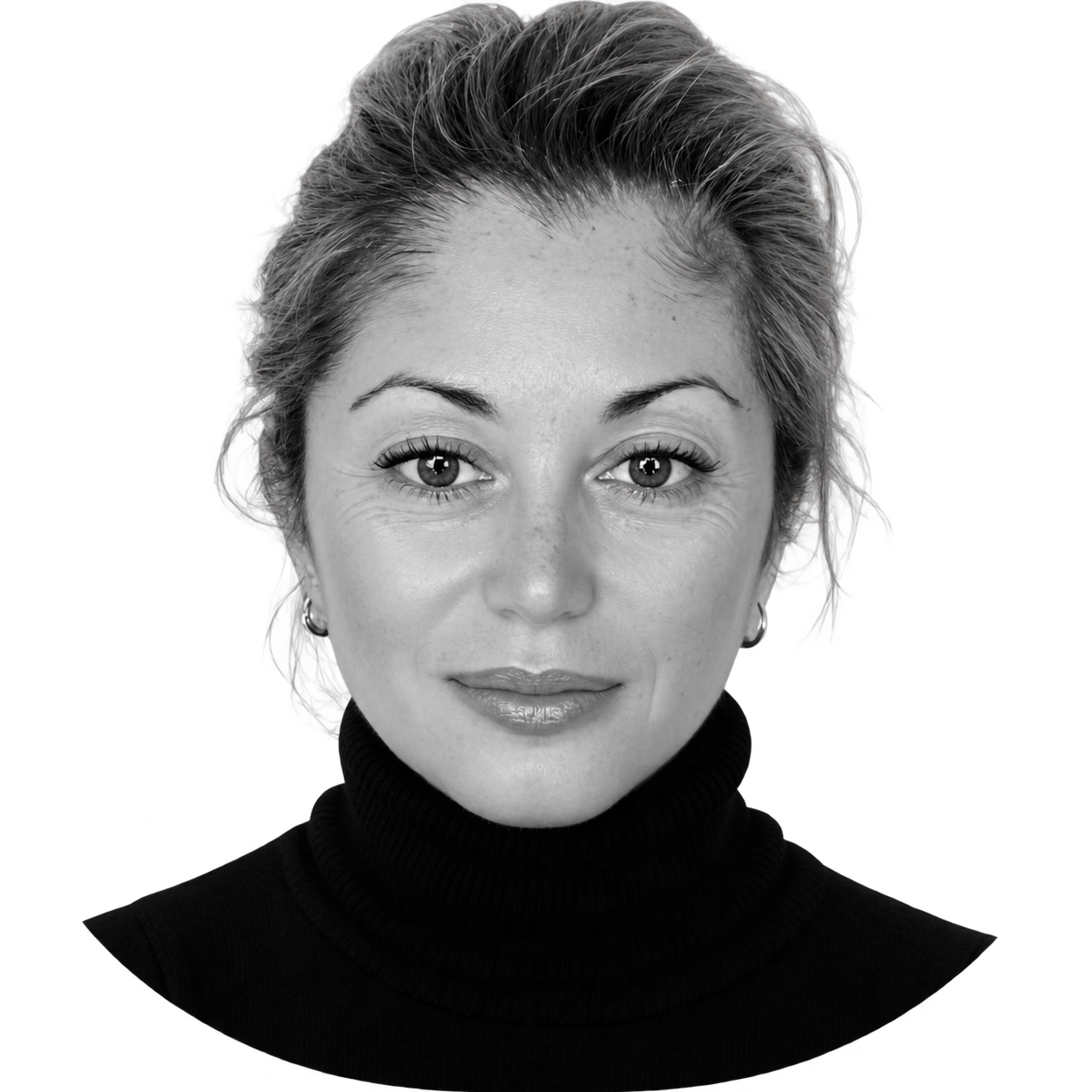
invisible woman
WOMAN
In September 2026, The Telegraph brought my story into the international spotlight.
Other newspapers and broadcasters picked it up. By my own count, it reached 45 publications.
Margo, my brilliant personal AI assistant, helps monitor the coverage and collects it in a database.
It is a peculiar experience, watching your private life become an international news story while your AI assistant organises the clippings.
The strongest interest came from Spain. At the centre of the coverage was my relationship with Laureano Pastor Veiga, a Spanish naval officer who served at NATO’s maritime headquarters in Britain between 2023 and 2025.
There was a relationship. There were military institutions. There were police. There were rumours about a Russian spy.
The woman connecting those things was me.
But the headlines began near the end of the story. To understand how I got there, you need to know something about the life that came before them.
How my private life reached the newspapers
The difficulties grew out of the hostility surrounding our relationship within parts of the Spanish military community.
Laureano and I had first been together in late 2024, separated in early 2025 and resumed our relationship in May. People around him disapproved. Alongside that disapproval, stories circulated about me being a “Russian spy”.
In June 2025, after he informed his superiors that we were together again, the situation moved into his professional life. He was interviewed by Spanish defence-intelligence officers, his access to his place of work was restricted, and our relationship became the subject of conversations with senior officers.
I could see the consequences. What I could not establish was what specific conduct was being alleged, whose information was being relied upon or how social hostility and spy rumours related to the official decisions.
Initially, I expected explanations.
There were conversations with NATO senior officers, security processes, restrictions and increasingly disturbing rumours. I wanted to understand what was being alleged, who was making decisions and what information they were using. About me, about Laureano, about us.
I supplied documents. I asked questions. I made complaints.
I also tried to interest journalists in the institutional story back in 2025. That proved considerably harder than interesting them in a story brought to public eyes in 2026 containing Tinder, NATO and a supposedly Russian woman.
For more than a year, the central questions remained unanswered.
In August 2026, I needed to travel to St Petersburg to visit my seriously ill father.
By that point, I was concerned that the narrative being circulated about me might have travelled beyond the British and Spanish institutions involved. Before travelling, I put questions to the UK Ministry of Defence, the Spanish Ministry of Defence, NATO and even the Polish Ministry of Foreign Affairs. I wanted to establish my security status, what information concerning me had been shared and whether it could expose me to difficulties in Russia.
None provided the substantive clarification I needed. I was left to make the decision at my own risk, without knowing what information might have reached Russia or what might happen when I arrived.
My father was seriously ill. I decided to go.
But first, as a precaution, I contacted The Telegraph and other British newspapers. I wanted journalists to have the documents, understand the background and know where I was going. If something happened to me in Russia, at least somebody would have the context.
My concern was given a disturbing new dimension in St Petersburg.
A day before I was supposed to travel back to Istanbul, I was approached a man who presented himself in a way that led me to understand he was connected to the Russian security services. He asked remarkably specific questions about my relationship and the Spanish military community around it. Some of the premises behind those questions were unfamiliar to me.
Weeks later, reading the Spanish coverage, I recognised elements of the same narrative.
I do not know how he obtained his information. I cannot identify who passed it to him. What I experienced convinced me that my concern about the story travelling to Russia had been well founded. It also left me with another question: how could somebody there appear to know more about the narrative surrounding me than I did?
Having just landed in Istanbul, I received a Whatsapp message from Tom Cotterill. He asked for an interview. Our conversation lasted nearly three hours.
I wanted to explain the machinery behind the story: how information about a person moves between institutions, how its meaning changes and how difficult it becomes to discover who is responsible for it. I asked a question - how a supposedly secret information about security concerns about me could have travelled far beyond NATO and MoD's intelligence circles?
The resulting headlines had a rather more cinematic vocabulary.
That is how I became visible.
This page is where I put the human context back.
Woman
Yes, I was born in the Soviet Union.
My contribution to that decision was extremely limited. My parents chose where to live. I arrived afterwards.
My family background is considerably more complicated than the phrase “Russian-born woman” suggests.
The grandfather behind the headlines
My maternal grandfather was a naval officer and naval pilot. In 1942, at the age of nineteen, he was called up from western Ukraine. He retired as Group Captain in late 1950s. His service is commemorated in a display at the naval museum in Kronstadt.
That part of my family history attracted particular attention from the international press.
For me, it was childhood.
I grew up around the habits, expectations and culture of a senior naval officer’s world. I understood hierarchy and discipline. I also associated that world with responsibility, courtesy and the expectation that an officer would protect the people close to him.
Those associations mattered when I met Laureano.
He was charming. His smile attracted me; his intelligence kept me interested. As I came to know him, something else felt familiar: he reminded me of my grandfather.
I associated that familiarity with safety.
We carry childhood into adult relationships, whether we notice it or not. Sometimes a person feels reassuring because he resembles somebody who once made the world feel secure.
I did not expect that feeling of safety to lead me into the events that followed.
My grandmother understood prejudice
My maternal grandmother was Romani.
In childhood, I heard how she had initially encountered prejudice within the circle of naval officers’ wives. She came from outside their world, and some people made sure she knew it.
My grandfather made his position unmistakably clear. He could be persuasive with words — and, when necessary, very persuasive with his fists.
My grandmother saw no reason to justify herself to anybody. She was who she was. Other people’s prejudices did not become her problem, and their approval was never something she sought.
They were a highly respected couple.
That family story shaped my expectations.
When I encountered hostility in Laureano’s social and military environment, I thought it would eventually be resolved. I imagined that the senior officers involved would exercise the judgment and authority I associated with their positions. People might disapprove of a new relationship, but ordinary boundaries would be restored.
Instead, I later discovered Spanish reporting describing me as “Red Sparrow”: a sexualised image of a Russian spy using a relationship with an officer to obtain information.
The contrast was extraordinary.
I had entered the relationship carrying a childhood understanding of dignity, protection and responsibility. What happened felt increasingly like a melodrama in which everybody had been given a script except me.
A family that does not fit one nationality
My mother was born in Estonia and was a British citizen.
On my father’s side, my roots are Ukrainian and Polish. As a teenager, I moved to Poland, received a Polish government scholarship and studied at the University of Warsaw, where I obtained a master’s degree in journalism and political science.
In 2004, I moved to Britain. In 2013, I became a British citizen.
That is the short version of a family history shaped by borders, migration and several cultures.
It helps explain why I find the emphasis placed on my birthplace so troubling. My mother’s Estonian birthplace did not prevent her from being a daughter of a Soviet naval officer and a British citizen. I never understood her identity as a contradiction requiring an explanation.
Yet in my own dealings with defence institutions, I have repeatedly had to confront the significance being attached to where I was born.
To me, a birthplace is one fact in a biography. The rest of the biography matters too.
The life I had already built
By the time I met Laureano, I had my own career, family and responsibilities.
Initially I was a solicitor and a governance professional.
In autumn 2025, as I began challenging the UK Ministry of Defence, the Spanish Ministry of Defence and NATO — three exceptionally powerful institutions, later joined in this story by policing bodies — I rapidly developed a new set of skills in Google technologies and AI architecture.
I built models that help me organise the evidence, reconstruct timelines, compare institutional accounts and manage the work across four legal proceedings. Those systems allow me to handle a volume of material that would otherwise be overwhelming. The legal judgment and responsibility remain mine.
There is a curious resource question here. Eight major UK human-rights legal practices declined to take on my case, citing "insufficient resources". I now conduct four proceedings as a litigant in person, supported by AI models I built myself.
Their decisions involved considerations beyond my own workload. Nevertheless, the contrast is striking: the work they could not resource has become work I can manage.
I had spent years making a life through education, work and decisions of my own. Meeting a naval officer became part of that life. It did not supply me with an identity.
That matters because, once the spy narrative took hold, ordinary details seemed to acquire new meanings. My birthplace, accent, relationship and even limited social-media presence became things other people interpreted.
Meanwhile, I was still the same woman: working, raising a daughter, falling in love with a man, who was not ultimately a slightest resemblance of my granddad, and trying to understand what on earth was happening.
Partner
Laureano and I were together twice.
The interruption between those two periods matters. So does the fact that we deliberately chose to try again.
The first beginning
We met on Tinder in late October 2024.
He told me that he was separated and that a divorce was in progress. We became close quickly, and in early November I moved into his private flat in west London.
Our relationship had an ordinary domestic reality. We shared a home, expenses and a bank account. We made plans involving our children, who were roughly the same age. We bought tickets for a New Year trip to Kraków.
On 12 December, I attended a NATO Christmas event at Northwood as his guest.
Two days later, we attended the Spanish officers’ Christmas dinner. Before that dinner, our table allocation was changed three times. Laureano had also been warned that it was “too early” to introduce me into the community and that bringing me could have consequences.
I experienced the atmosphere as hostile.
Still, I thought we were dealing with social disapproval: an uncomfortable new relationship, a separation, people taking sides.
I expected adults to manage it.
The first separation
In January 2025, Laureano came home deeply distressed. He told me that I was a Russian spy and that we had to separate.
I did not understand what had happened at work or who had said what to him.
Between February and late April, we had no contact.
In April 2025 we began talking again. By late May, we had resumed the relationship.
I chose to try again because I loved him and believed that we could build something together.
The second beginning
In early June, we travelled to El Puerto with our daughters.
We were making plans for a shared future. Marriage. A child. A home. The practical arrangements that follow when two people decide to take each other seriously.
On 16 June, Laureano informed his senior officer that we had resumed our relationship and asked for the relevant administrative matters to be regularised.
Within days, our lives were caught up in security interviews, access questions and decisions we struggled to understand.
On 18 June, he was interviewed by Spanish defence-intelligence officers. The following day, a question arose about whether my earlier entry to Northwood appeared in the British system. I still had a photograph of my pass. Once I supplied it, the entry was located and confirmed as lawful. Later it appeared to become unlawful again and Laureano's pass to his place of work at Northwood was suspended on 20 June.
On 22 June, he met Admiral Delgado. Laureano explained that we were together, pursuing fertility treatment and intending to have a child.
My reading of that conversation is that pressure to end our relationship occupied a central place in it.
So from June Laureano was on "special leave", sitting at home and not working whilst attempting to find out what happened.
By early July, I had moved in with him into the Ministry of Defence accommodation where we started living together together. MoD has received a notification about it, but never processed it.
At the same time, I was supplying information about myself and asking for explanations. I expected that facts could resolve misunderstandings.
Instead, I found myself trying to establish what people believed I had done.
When I began asking different questions
Over that summer, social life narrowed. Invitations disappeared. People became unavailable. We organised a barbecue and invited thirteen people.
All thirteen declined.
I cannot explain every individual absence. But I remember the accumulating experience of exclusion, alongside professional and security processes whose factual basis I could not establish.
By September, I felt that the psychological pressure had become more than Laureano could bear. On 17 September 2025, he attempted suicide. I intervened and saved his life, and he was taken to hospital.
Afterwards, his wife — they were still legally married — came to Britain and took him back to Spain.
That was how our relationship ended. Only a few months earlier, we had been planning marriage and a child. Now he was gone, and I was left trying to make sense of both the personal devastation and the institutional decisions that had surrounded our lives.
I was left with the personal loss and with questions that existed independently of it.
What had been recorded about me? Who had supplied the information? What had been checked? How had it entered military and civilian systems? How could I challenge something I was not allowed to see clearly?
I became angry.
And I began doing what my professional life had taught me to do: reading documents, testing explanations and asking people to account for decisions.
Then I realised that I needed to go further.
The institutions I was challenging controlled much of the information I needed to understand what had happened. They also had resources I could not begin to match. I was trying to reconstruct decisions from their consequences, while the people holding the records decided what I could see.
I needed new skills, quickly. I needed resources. I needed allies.
I joined a Google Developer Group. I began studying, building AI models and workflows, and testing how they could help me analyse the evidence. As I worked, my understanding of the problem expanded. I could model several competing explanations simultaneously, examine each on its own terms and identify where they failed to fit together.
That became part of the work I developed through Alien Mind.
One approach was rift-based modelling: using AI to construct and compare different frameworks for the same events. What did each institution treat as a fact, a decision or a responsibility? What happened when its account was placed alongside mine — or alongside another institution’s? The incompatibilities became points to investigate.
I also developed litigation meta-architecture: a way of designing connected legal proceedings when the information needed to understand the dispute remains under the opponent’s control. Each independently arguable case asks different questions. The answers can help reveal who decided, what was recorded, how information travelled and where responsibility lies.
I was learning to turn fragmented responses into a structure I could examine and challenge. The models helped me do that. The judgment, decisions and responsibility remained mine.
This became a decisive struggle in my life.
Other people had attached labels to me and allowed those labels to acquire consequences. I decided that I would not leave their versions of me unchallenged.
If I needed to learn another discipline, build new tools and change how I thought to pursue the answers, I would.
And I did. I still do.
Mum
I already have a daughter.
My daughter is grown up, talented and studying in America. She plays football professionally, combining sporting ability with intelligence and ambition. I am enormously proud of the life she is building.
She was born in Britain. Before her matches, she sings the American national anthem. Watching her, I see how naturally a person can belong to more than one place.
If she chooses to make her life in America, I feel confident that she will be valued for who she is and what she contributes. I hope she will never experience what I have: having her birthplace treated as grounds for suspicion, as though she had somehow been born in the wrong country.
I want her to be able to build a future without having to defend the geography of her birth.
I am enormously proud of her.
Invisible Woman is where I tell my story and follow those questions.
The documents matter. The decisions matter. Accountability matters.
And the person whose life sits underneath them matters too.
