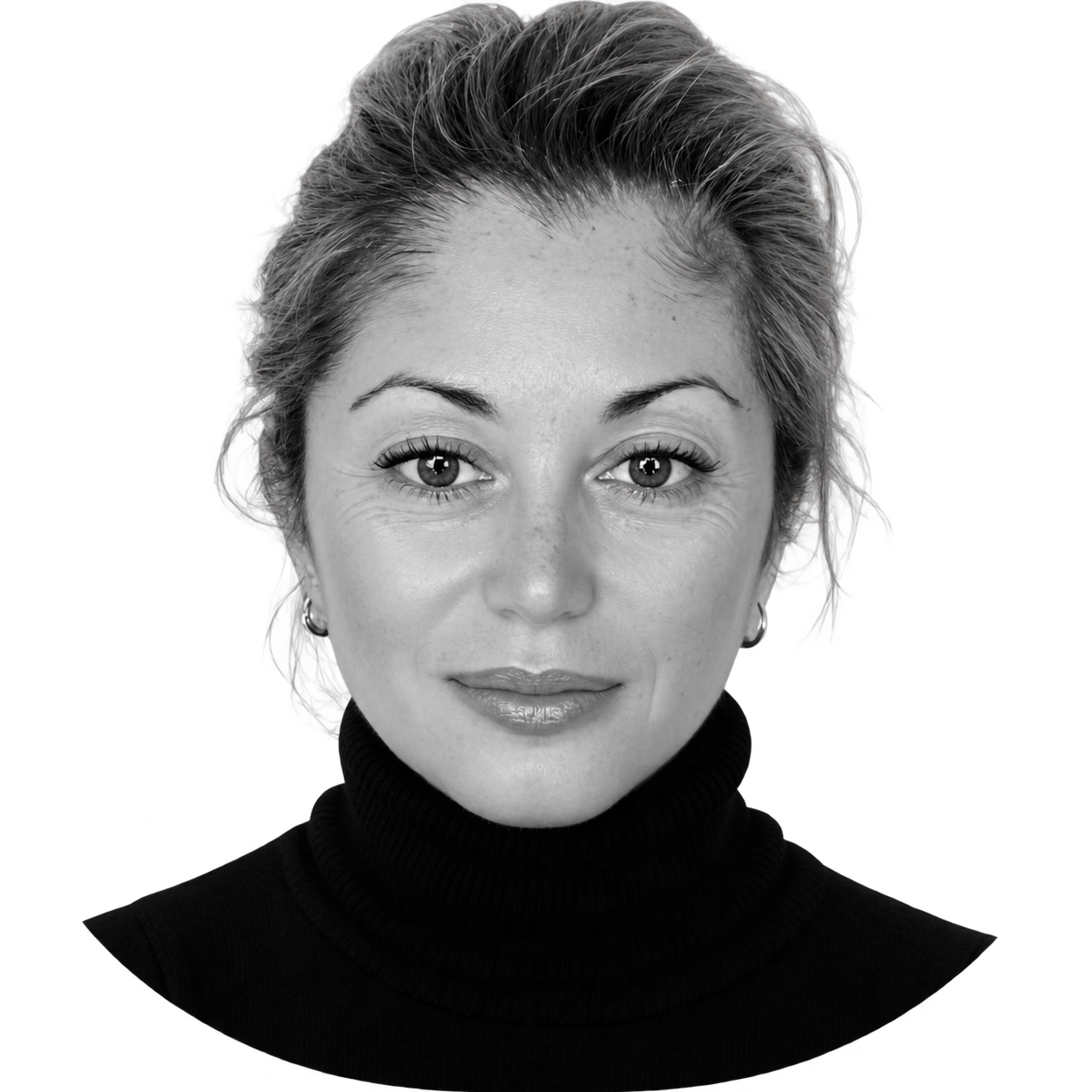
invisible woman
FIND THE SPY
PART ONE — THE SUSPECT
Imagine that you are a counter-intelligence officer.
It is an ordinary morning in your office where ordinary mornings are rarely quite what they seem.
Beyond the window, London's autumn 2026 is disappearing into the sort of grey rain that makes even the most important government buildings look faintly apologetic. On your desk stands a cup of coffee, already cooling beside a pile of correspondence that nobody else appears particularly eager to read.
Then a new file arrives.
There is nothing theatrical about it. No mysterious courier, no red wax seal, no urgent instruction from the Prime Minister. Just a dossier concerning a woman whose relationship with a NATO naval officer has become the subject of an international security controversy.
You open it.
Janina White. Born in Leningrad, Soviet Union. British and Polish citizen. Solicitor.
The photograph shows an attractive woman in middle age, with an expression suggesting that she is perfectly capable of explaining something to you at considerable length and would probably enjoy doing so.
You turn to her family background.
Her grandfather was a Soviet naval aviator, Captain First Rank, whose wartime service is commemorated in naval museum in Kronstadt. The granddaughter left the Soviet Union in 1991, lived in Poland, acquired Polish citizenship and eventually moved to Britain, where she qualified as a solicitor.
You make your first note in the margin.
Family background: Soviet naval aviation.
It is not evidence of anything, of course (you try not to think about your boss's grandad). You have been in this profession long enough to know that a grandfather's military career does not turn his granddaughter into an intelligence operative. Nevertheless, family histories sometimes reveal connections, opportunities and loyalties worth understanding.
The next pages concern her education.
Journalism and political science. Law. Corporate governance. Information, OSINT. Artificial intelligence. An extraordinary accumulation of professional training, including approximately sixty Google certificates.
You have encountered people who collect qualifications before. Most of them are harmless, although they can be exceptionally difficult to interrupt.
Then you find something more interesting.
In 2020 and again in 2024, White attended training involving Andrey Masalovich, a Russian cybersecurity and information-analysis specialist whose publicly described professional background includes work in state communications and security structures. The Cuber Grandad. The father of "Russian Palantir".
You recognise why the name has been included.
A woman born in the Soviet Union has studied intelligence-related analytical techniques with a Russian specialist.
That does not establish espionage. Intelligence-analysis methods are taught openly and used by journalists, researchers and businesses. But you would be negligent to ignore the connection without understanding its nature.
You underline the name and write:
Nature of training? Subsequent contacts?
Then you discover that the woman has applied for employment within NATO structures.
Three applications. One for a temporary position in Brussels and two associated with Allied Maritime Command.
You study the dates, comparing them with her professional history.
Perhaps she simply wanted a job. With her qualifications, it would hardly be surprising. But from a counter-intelligence perspective, an employment application is also a potential route into an institution, offering opportunities to acquire contacts, understand procedures and, if successful, obtain authorised access.
You add another note.
Potential access route through recruitment.
By now, your coffee has gone cold.
The next photograph is of a Spanish naval commander.
Laureano Pastor Veiga, serving at NATO's Allied Maritime Command at Northwood, near London in 2023-2025. The photograph shows him beside White, smiling with the unguarded confidence of a man who has not yet discovered how thoroughly his private life is about to become entangled with his professional one.
They met on Tinder in October 2024.
You smile despite yourself.
The great intelligence services of the twentieth century invested enormous resources in arranging apparently accidental encounters. In the twenty-first, it seems, an algorithm can do the introductions for free.
Their relationship develops quickly. The commander introduces White to his military environment. She attends social gatherings and accompanies him to Northwood, including a Christmas event in December 2024.
According to subsequent reporting in the Spanish press, some of his colleagues become suspicious. White is Russian-born, speaks with an accent and allegedly asks questions about officers' names, postings and responsibilities.
Somebody gives her a nickname.
Red Sparrow.
You know the reference immediately. The beautiful Russian woman whose romantic involvement with a Western officer conceals an intelligence mission.
It is an old story, and a rather lazy one. But lazy stories can be dangerous when people begin to treat them as intelligence assessments.
You write:
Establish actual conversations at Northwood. Identify witnesses. Potential honeytrap.
Then you reach the shooting video.
The location is a Ministry of Defence training range in the English countryside, a controlled military facility where, according to the account accompanying the footage, Ukrainian marines have trained before returning to the war.
White is a civilian, yet she is there with her Spanish naval officer.
You watch her lift the rifle and take aim.
You see a shot striking two targets positioned at one hundred and two hundred yards. At three hundred yards, she hits the target on her first attempt. Repeatedly.
You watch the sequence again.
The original footage would need technical examination before every detail could be accepted.
Nevertheless, the woman clearly has an interest in precision shooting, and the performance is sufficiently striking to attract attention.
Then you listen to a recording of a former Spanish marine, who tells her partner that she possesses military training.
You pause the video.
A Russian-born woman with intelligence-analysis training, NATO employment applications, a relationship with a naval commander and an apparent talent for long-distance shooting as well as tactical shootings skills of a standard of a military training.
You have seen weaker intelligence leads.
But the circumstances are peculiar. The commander himself has apparently been showing the footage to people on WhatsApp, evidently proud of his girlfriend's abilities. If this is a clandestine operation, it is not being conducted with much concern for discretion.
You write:
Verify shooting history, range permissions and reported military assessment.
Then you find a passage that initially strikes you as comic.
You see the screenshots of the Spanish commander's exchange with his friends, where he tells them that she might one day kill him. They respond that he would die in pleasure.
You can almost hear the conversation: a Spanish officer enjoying the theatrical possibilities of his Russian girlfriend, borrowing his imagination from spy films while she laughs at the absurdity of it all.
But the next pages are not amusing.
In June 2025, Spanish military counter-intelligence officers question the commander at Northwood. His access to the British installation is withdrawn. The Spanish authorities suspend his security clearance, and his international posting subsequently comes to an end.
His professional and personal circumstances deteriorate.
Months after the earlier jokes about being killed by a dormant Russian agent, the commander experiences a life-threatening crisis. According to the woman, who is suspected to kill him one day, he attempts suicide and requires hospital treatment. She says she helps obtain emergency medical assistance and she kept him alive whilst the ambulance was on its way.
You turn back to the earlier passage.
The man who joked that his girlfriend might kill him has nearly died.
You make a careful note.
No causal connection established. Serious personal consequences. What the f*** happened that day?
The next section concerns Portugal.
STRIKFORNATO — NATO's Naval Striking and Support Forces command — operates from Oeiras, near Lisbon. In late June 2025 it is hosting NEST 25-2, a professional NATO planning event.
Only days after the Northwood security crisis, where he is suspended from his place of work due to security concerns in Britain, the commander travels to Portugal.
That suspicious woman, whose British record is also endorsed with a security tag, accompanies him onto the installation.
She spends time in recreational areas while her partner attends his duties and plans on how to defeat Russian naval operations across the most important strategic geopolitical basins.
The timing is remarkable.
At Northwood, security concerns have resulted in access restrictions. At Oeiras, the commander and that woman, who cause all these cobcerns are admitted under arrangements that you have not yet examined.
You write:
Obtain NEST 25-2 visitor records and sponsorship correspondence. Who let them in???
The next document concerns communications.
On 28 June 2025, while the strange couple are still in Portugal, in Sintra, the commander discovers, the next day after the STRIKFORNATO event is over, that WhatsApp messages have disappeared from his telephone. Some later reappear. Others do not. His personal email account is also behaving unexpectedly.
The anomalies are reported shortly after the counter-intelligence interview and the withdrawal of his Northwood access.
You have seen enough technical incidents to know that disappearing messages can have entirely ordinary explanations. Failed backups, synchronisation problems and account settings can produce alarming results. Equally, unauthorised access cannot be ruled out without examination.
The couple report their concerns and seek investigation.
You make another note.
Obtain forensic findings, if any. Find out how the reports have been investigated.
Finally, you reach St Petersburg.
In August 2026, White meets a man who claims to be an officer of the FSB. He questions her about the Spanish commander and appears to possess private information concerning their relationship.
His identity is unverified. The origin of the information is unknown.
Nevertheless, the allegation is extraordinary.
You close the file and look at your notes.
A Soviet naval family. Russian intelligence-analysis training. NATO job applications. A relationship with a Spanish commander. An impressive shooting video. Access to military installations. Security restrictions, a personal tragedy, disappearing communications and an alleged encounter with Russian intelligence.
It is an almost implausibly rich collection of circumstances.
You know that none of them, separately or together, proves espionage. But you also know that dismissing the entire dossier without examining the evidence would be professionally irresponsible.
You take a clean sheet of paper and write your preliminary recommendation.
The allegations warrant careful investigation. Establish the facts before drawing conclusions.
Then you place the dossier to one side.
For the moment, you have only one task.
Find out what your colleagues did over the last 2 years to investigate these concerns.
PART TWO — THE INVESTIGATORS
Some time later, another file arrives on your desk.
This one is different.
The first dossier concerned the woman and the circumstances that had attracted suspicion.
The second is supposed to tell you what your colleagues have done about those suspicions during the nearly two years since the relationship began.
You expect to find the results of a substantial investigation.
After all, the affair has involved British and Spanish military authorities, NATO structures, counter-intelligence interviews, security restrictions, complaints, litigation and international press coverage.
You open the file, expecting witness statements, technical reports, assessments and conclusions.
Instead, you find a complicated administrative history.
You begin with Northwood.
The Spanish commander was questioned by CIFAS, the Spanish counterintelligence. Security concerns were raised. His access was withdrawn. His Spanish clearance was suspended. His posting ended. But you cannot find a CIFAS file. You find a Spanish decision by the Spanish Ministry of Defence that the commander's HPS (Security clearance) is suspended because of concerns raised by British MoD.
You are are trying to find that British document. It states that there are concerns about Ms White, which needs to be investigated. Concerns are not explained. You cannot see any signs of any security assessment of investigation.
So you examine the British Ministry of Defence's November 2025 legal response to Ms White's judicial review challenge.
It records that the investigation concerning the commander and White's place of birth were relevant factors in the access decisions. It also states that no UK decision-maker determined White to be a national-security threat.
You read that sentence again.
The distinction is important. A precautionary access restriction is not necessarily a finding of espionage. Investigating a serving officer's security position is not the same thing as establishing that his civilian partner works for a foreign intelligence service.
You look for a recorded interview with White about the alleged espionage concern.
None is identified in the material before you.
That does not mean no such interview or assessment exists. Classified investigations are not always disclosed. But you cannot evaluate material you have not seen.
You turn to the next document, expecting to find evidence of what happened after the security restrictions were imposed.
The commander has lost his unrestricted access to Northwood. Security records have been created concerning him and the woman. Spanish counter-intelligence has already become involved. By any reasonable measure, the matter is serious.
Then you discover that the commander subsequently meets his commanding officer.
At last, you think, here is an opportunity to understand how the security concerns were being addressed at command level. You expect to find a discussion about the alleged threat, the evidence supporting it, the implications for the officer's clearance, or perhaps the steps necessary to bring the investigation to a conclusion.
Instead, you find a discussion about woman's pregnancy.
You stop reading.
Pregnancy?
You return to the previous pages, checking the chronology. The security restrictions are already in place. The commander's professional position is in jeopardy. The woman has become the subject of a security-related access record. Yet the documented conversation appears to concern something quite different from the extraordinary allegations that brought you to this file.
You make a note in the margin.
What was the purpose of this meeting? Were the security concerns discussed separately? What records exist of any substantive review? How couple's reproductive planes were related to security concerns?
The conversation about pregnancy does not establish that the commanding officer ignored the security matter. There may have been other meetings, other discussions, other documents that you have not seen. Hmm, there are many documents you have not seen, you realise.
But the juxtaposition is remarkable.
You came to this file looking for the institutional response to a suspected Russian intelligence threat. And here, amid the restrictions, investigations and professional consequences, you find a conversation about future babies.
You turn the page, hoping that the next document will explain what happened to the security investigation.
T woman's NATO job applications.
The Brussels vacancy has expired. The two MARCOM applications were reportedly submitted, but apparently vanished in thin air, as MARCOM does not keep documents on candidates, who were not shortlisted.
Ok, she may have not been shortlisted, but she was a security concern and her partner was a MARCOM officer. Where is that information???
You turn to the Russian instructor.
You expect an internal secret report establishing the process of discovering that implicating connection. You cannot find any. Then you discover that it the woman herself, who disclosed these trainings in her own NATO job application. The woman has discussed the training openly.
The material before you contains no established operational connection between the courses and a clandestine intelligence activity.
You return to the shooting video.
This time, instead of concentrating on her performance, you examine how she came to be at the range.
It is a controlled Ministry of Defence facility, with quite complicated admission policy, and the woman appears to have attended in circumstances, which did not involve the Spanish commander. The precise permissions still require verification.
The footage was apparently circulated by the commander himself. White's interest in shooting was hardly a secret.
You watch the video once more.
The woman can shoot. That is clear.
Whether she has military training, who taught her and what significance any of this might have for national security remain separate questions. You look for this assessment, you find none.
You make a note:
Marksmanship is not evidence of intelligence affiliation.
Then you open the Portuguese file.
This is where the second dossier begins to surprise you.
You expected an unexplained entry onto a NATO installation shortly after a security controversy.
Instead, you find administrative correspondence concerning the visit to STRIKFORNATO during NEST 25-2.
There is a sponsorship arrangement being processed via Brussels HQ. There are communications concerning the civilian visitor.
The commander is attending a professional military event, and White is accompanying him under the arrangements recorded in the correspondence.
Then you notice something peculiar.
At one point, White has been included in a chain of communications relating to the arrangements, and she is distinctly angry about it.
She wants to know why military-related correspondence is being copied to her.
You read the exchange again.
The woman who, according to the original suspicion, might have been seeking access to NATO information is objecting to being included in correspondence she considers inappropriate for a civilian.
You lean back.
It does not prove innocence. An intelligence operative could behave in precisely that way. But it complicates the theory, and a competent investigator does not simply ignore evidence because it is inconvenient.
The visit appears to have been processed through administrative channels. The woman objected to being drawn into certain communications. Meanwhile, the access restrictions at Northwood remained part of the wider security controversy.
You make a note:
Establish why the two installations reached different access outcomes. Review full email chain.
Then you examine the reported communications anomalies.
The second dossier contains complaints and correspondence about WhatsApp, personal email and concerns involving an unclassified NATO-issued laptop.
The incidents were reported in 2025. The couple pursued the matter through subsequent complaints.
In October 2026, Aurelio Ruiz Enebral breaks a detailed investigation about it in El Confidencial Digital.
You compare the reporting with the available documentary chronology.
You can see that concerns were raised by the commander. You can see the questions the couple asked. But you cannot identify a conclusive forensic explanation in the material before you. You see no report that the concerns were investigated.
There is no basis for declaring that the messages were hacked. There is equally no basis, from these documents alone, for confidently explaining every anomaly as an innocent technical failure.
You write:
What investigation was undertaken? What were the findings?
Then you return to the alleged FSB encounter in St Petersburg.
White has described the episode publicly and to journalists. Her account is unverified, but she is identifiable and apparently willing to answer questions.
You look for a recorded interview with her by the relevant security authorities concerning that encounter.
None has been identified in the available material.
Once again, you cannot infer that no classified work occurred. But the record before you does not allow you to reconstruct what was done.
By late afternoon, you are beginning to notice a pattern that has nothing to do with Russian intelligence.
The first dossier was full of material that made the woman appear suspicious.
The second is full of administrative decisions, correspondence, complaints and unresolved questions.
There have certainly been investigations concerning the Spanish commander. But you are not able to locate formal investigation outcome reports. There have been security restrictions and institutional responses. Plenty of that evasive legal bullshit. But no formal security assessments.
And you still cannot establish, from the material available to you, the complete evidential basis for treating White herself as an espionage concern.
And there is another peculiarity.
It looks like that the woman has been conducting her own investigation. Against those, who are supposed to investigate her. The prey became the predator. You laugh.
She has meticulously collected documents, reconstructed dates, compared official accounts, pursued information requests and challenged administrative decisions. She has approached journalists, published analyses and used artificial intelligence to examine complex documentary records.
You look back at the first dossier.
The woman who was considered suspicious partly because of her ability to collect and analyse information has used that very ability to investigate the institutions that suspected her.
You think about the shooting video, the NATO employment applications, the Christmas reception, the Portuguese visitor paperwork, the disappearing messages and the alleged FSB encounter.
Each item once appeared to fit a single alarming narrative.
Now, having examined the available documents, you see that several have alternative explanations, others remain unresolved, and some require evidence that has not been made available.
You cannot conclude that the woman is innocent merely because she has been open about much of her life.
You cannot conclude that the authorities did nothing merely because you have not seen their complete records.
But you can see the peculiar shape of the case.
The first dossier asks you to investigate the woman.
The second asks you to investigate the investigation.
You look at the two files lying side by side on your desk.
One contains suspicions about a possible Russian spy.
The other contains evidence of how those suspicions were handled, challenged and documented.
You take out a fresh sheet of paper.
Your conclusion is cautious, because the evidence demands caution.
I cannot establish from the available record what my colleagues did to investigate her.
Then you look at the correspondence White has assembled, the questions she has asked and the documentary trail she has reconstructed.
You add another sentence.
But I can see what she did to investigate them.
You close the second dossier.
And now you are left with a question you had not expected to ask when the first file arrived.
Who was investigating whom?
PART THREE — THE INVESTIGATION
And now I have a confession to make.
The counter-intelligence officer whose desk you've been sitting at does not exist. I invented the office, the files arriving in the morning and the notes you made in the margins. But the underlying controversy, the documents, the press reporting and the unanswered questions are real.
And now I want to ask you something.
What if the counter-intelligence officer were you — for real?
I've recently been having fascinating conversations with film and television producers about adapting Invisible Woman into a scripted drama series. I'm excited about the possibilities, but fictional television takes time, and this story is still unfolding.
So I've had another idea.
Why don't we make an investigative documentary with elements of a reality show?
Not another film about a romance that went wrong. Not two hours of me explaining why everybody else is mistaken. I want something more adventurous.
I want independent investigators to examine the woman from the dossier.
Me.
Laureano used to tell me that I was a Russian spy who simply hadn't been activated yet. A sleeper agent, apparently waiting for instructions. Perhaps one day I would smell a particular perfume and develop an irresistible urge to assassinate NATO officers. Perhaps there's a secret telephone number hidden in my subconscious that connects directly to Vladimir Putin.
I find the possibility rather intriguing.
What if he's right?
I don't know.
Let's find out.
Imagine a team of experienced investigators — former counter-intelligence professionals, investigative journalists, digital forensic specialists — examining the documents, interviewing witnesses and challenging my account.
I will cooperate. I will answer difficult questions. I will make relevant records available under appropriate legal safeguards.
I will even consider a polygraph, not because it can scientifically establish truth or deception, but because watching an extraordinary account being questioned in that setting could make compelling television.
Imagine an independent examiner asking me about the man who claimed to be an FSB officer in St Petersburg.
Where did we meet?
What did he say?
What did I say?
What did he appear to know?
Could any of it be independently verified?
Or imagine two experienced private investigators reconstructing my relationship with Laureano, not the intimate details but the conversations, introductions, dates and events that might actually matter to an investigation.
I have a rather unusual memory. I can work with lengthy documents and often remember approximately where particular information appears. More importantly, I recognise patterns and connections across large amounts of material.
But memory is not infallible, and seeing patterns does not mean every apparent connection is real.
That is exactly why independent scrutiny would be interesting.
Perhaps I would remember something important. Perhaps I would confuse two conversations. Perhaps a document would contradict my recollection.
Good.
I want to know.
And imagine two investigations running simultaneously.
One in Britain, examining Northwood, the Ministry of Defence and the institutional record.
One in Spain, examining the military decisions, witnesses and administrative history.
Two investigators working from opposite ends of the same tunnel, neither knowing whether they will meet in the middle.
The investigators would have to be independent. They would not work for me, and I would not have an editorial veto over properly evidenced findings. The production would respect privacy, confidentiality, legal privilege and ongoing proceedings, while giving those criticised a fair opportunity to respond.
Perhaps they would find something genuinely suspicious.
Perhaps they would find ordinary explanations for extraordinary rumours.
Perhaps they would uncover institutional failures.
Perhaps they would discover that I had misunderstood something important.
Any of those outcomes would interest me.
Because the point is not to manufacture a verdict. It is to watch a real investigation unfold.
And the best part is that we would not have to invent what happens next. New documents, new responses and new questions are still emerging.
So, dear viewers, you've spent the last few minutes occupying the chair of a fictional counter-intelligence officer.
Now imagine taking that role beyond the page.
Would you watch independent investigators test the story?
Would you follow them through Britain and Spain as they tried to separate espionage from rumour, security precautions from proven threats and coincidence from evidence?
Because I'm here.
I'm willing to answer the questions.
And I'm genuinely curious about what they might discover.
Perhaps they'll find a Russian spy.
Perhaps they'll find a spectacular collection of misunderstandings.
Or perhaps they'll find a much bigger story about how suspicion acquires institutional authority.
I don't know.
But wouldn't it be fascinating to find out?
And if somebody discovers the secret activation code for my alleged sleeper-agent programme, I would be grateful if they told me.
After all, it's my brain.
I think I ought to know what's in it.
And today's song is SHE WOLF
