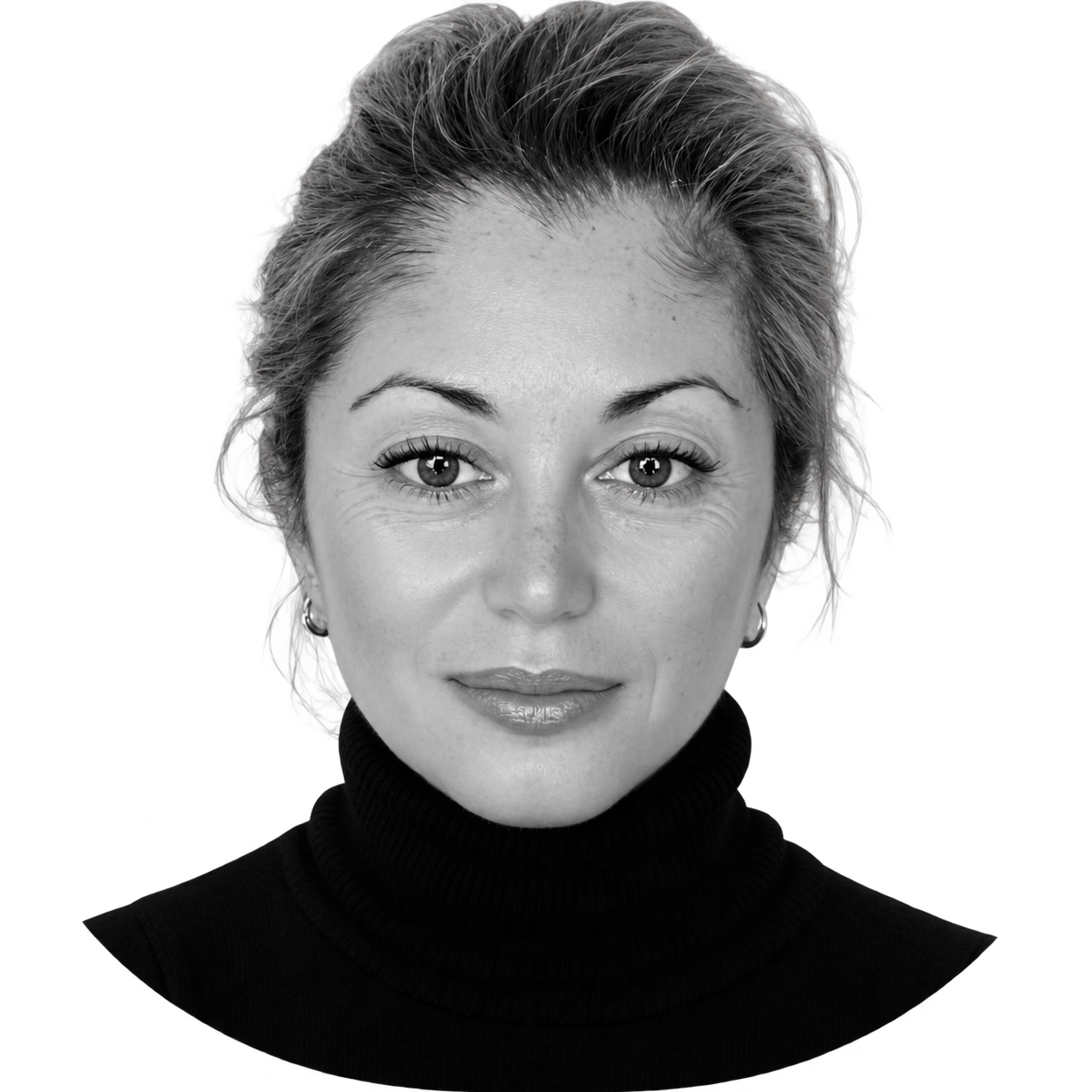
invisible woman
I AM UKRAINE
Tomorrow, 14 October, I will look back on the first month since my private life became an international newspaper story. Before counting the headlines, I want to explain what came before them. Otherwise, the woman answering publicly can easily be mistaken for the woman who wanted a public confrontation in the first place.
On 14 September 2026, The Telegraph published an account of my relationship with Commander Laureano Pastor Veiga, a Spanish naval officer who had served at NATO's Maritime Command in Northwood. The Times followed, and then the Spanish press. A relationship, a Soviet birthplace, Tinder and the language of espionage supplied an exceptionally marketable combination. Questions about institutional decision-making suddenly acquired a much louder, more sensational frame.
I am a British and Polish citizen and a solicitor of England and Wales. The circumstances behind those headlines had already occupied well over a year of my life. They involved hostility within a military community, decisions affecting my former partner, labels applied to me, an individual access restriction concerning me, a police encounter and repeated attempts to obtain explanations. Some of these matters are documented in official records; others remain allegations in contested proceedings. My interpretation of the whole sequence is not a judicial finding.
But my reasons for asking questions are mine to explain.
After the coverage began, I created Invisible Woman on LinkedIn: a place for the documents, the personal account and the questions that could not be answered inside a headline. That page has since been removed. I have now built a home for the work on my own website. Rather than simply restore every text unchanged, I am taking the opportunity to develop the thinking behind it.
This article, "I am Ukraine", first appeared on 23 September on that page, which had been removed. I am returning to it today because the first month's public record makes little sense without the much longer private history. It also makes little sense without understanding the different ways I have tried to respond. I have now taken the opportunity to develop some ideas in the initial article here.
I am also returning to cultural codes and the social habits they shape for another reason.
Tomorrow, I will take stock of the first month of public exposure through the lens of the British cultural code: its expectations of fairness, restraint, institutional responsibility and how disagreements should be handled. Before examining those expectations, I want to understand the cultural resources I brought to the encounter myself.
There was a period zero
In 2025, Laureano and I still believed that institutions would respond if we explained the circumstances clearly enough. We wrote, complained, supplied information and asked for protection and clarification. We expected someone with authority to examine the problem and resolve it.
That belief was sincere. A concern could be checked. A misunderstanding could be corrected. If somebody had made an unsupported assumption about me, my passports, professional history and actual conduct could be examined. If procedures had gone wrong, the institution could put them right.
I was still addressing the system as something capable of protecting us from what was happening within it.
The phases overlapped. I approached journalists as early as July 2025, while we were still trying institutional and legal routes. On 8 July, I wrote to Danielle Sheridan at The Telegraph, forwarding Laureano's account of concerns about governance and due process. On 9 July, I contacted Larisa Brown at The Times. The question we wanted examined was institutional accountability. Those approaches did not produce the public eruption that came more than a year later.
Period zero continued even after our approaches to the press produced no interest and our requests to the institutions produced no substantive answers. A problem affecting two people had remained a problem for those two people. I still believed it could be resolved through a quiet dialogue, so I continued addressing the institutions, now through their lawyers.
The questions remained basic: what had been decided about me, by whom, on what information, and why had I not been told?
What I received, in my experience, was further minimisation, more labels and another round of humiliation. Yet I continued trying to explain my position, still expecting that a clear account and a reasonable request would eventually produce meaningful engagement.
Period 1 started in March 2025
By March, I had spent months trying to obtain a clear explanation through correspondence with the institutions and their lawyers. My first judicial review was already underway, and I had made an N244 application within it. Yet I was still trying to resolve the underlying problem quietly. I continued to believe that a precise question, supported by documents and placed before the right people, would produce an answer.
Eventually, I stopped believing that further exchanges with the lawyers would achieve that. Quiet dialogue had become a process I was sustaining without obtaining the clarification it was supposed to deliver. I needed to change my approach.
On 21 March 2026, I withdrew my N244 application within that judicial review. I did not withdraw the judicial review itself. The application ended; the underlying challenge continued.
For me, that distinction marked a larger change. I had concluded that the exchanges with the lawyers were not producing the clarification I needed. I stopped organising my entire response around the hope that another carefully formulated request would finally unlock an answer.
Period Two: Building Other Routes
From 21 March 2026, I began working differently. Documents, complaints and information requests became more than separate attempts to obtain an answer. I started bringing them together, comparing what different institutions said and examining how information had moved between them. Over the following months, I also began reconsidering how to involve journalists.
I returned to the accountability question I had first put to the press in July 2025, now supported by a much larger documentary record. I wanted journalists to examine who had made the decisions, what information had been used and why the people affected had been unable to obtain a clear explanation.
That return to the press had a history. On 8 July 2025, I had written to Danielle Sheridan at The Telegraph, forwarding Laureano’s account of what had happened. His message began: “not in pursuit of scandal”. We wanted scrutiny of military governance, due process and accountability. The following day, I approached Larisa Brown at The Times with the same essential concerns. Neither approach resulted in a published story.
By the summer of 2026, I had a larger documentary record and more precise questions. Review Wye recorded that civilian police had been told that Laureano and I were “under investigation”. Separately, it recorded a RAF Police officer’s awareness of a “Russian spy” rumour. Meanwhile, the Ministry of Defence’s court pleading stated that no UK decision-maker had determined that I was a threat to national security. These were different propositions, and I wanted to establish how they related to one another.
In July 2026, while considering a visit to my elderly father in St Petersburg, I again approached NATO, the Spanish authorities, the Ministry of Defence and government lawyers.
What information existed about me?
Was I under investigation, or being treated as though I were?
Who owned any relevant record?
Did it remain active?
Had it been communicated elsewhere?
I sought the minimum factual clarification necessary to understand my position and make my own decisions. The exchanges did not provide that clarification.
On 19 August 2026, I wrote to Tom Cotterill at The Telegraph. This time, I began with the documentary discrepancy: serious security-related descriptions recorded inside the institutional system, alongside a court position denying that any UK decision-maker had designated me a national-security threat. I asked him to examine how those descriptions had arisen, who had communicated them and what decisions they had supported.
Tom replied, requested the documents and began asking questions. I made one distinction explicit: I did not know whether I had been formally investigated at all, or for what. A recorded statement that somebody was “under investigation” could not establish that an investigation existed. Nor could an officer’s knowledge of a rumour establish that the rumour had become an official assessment.
On 20 August, I told him that I would be travelling to Russia on 22 August to visit my father. I explained that I took responsibility for that decision and was not suggesting that detention or another adverse event was inevitable. I wanted the uncertainty examined, without presenting a feared outcome as a fact.
That was the renewed engagement with the press: a sequence of documents and testable questions about institutional accountability. When the story entered the newspapers on 14 September, it acquired a sensational frame. But the questions I had brought to journalists concerned provenance, verification, decision-making and the ability of a person affected by state action to discover what had actually happened.
Period Three: 14 September — The Story Became Public
Until then, I had been putting documents and questions before individual journalists. Publication brought a different challenge: responding to a story whose public framing I could influence, but could not control.
Then, on 14 September, the circumstances changed again. I had chosen to seek journalistic scrutiny. I had not chosen every headline, insinuation or editorial emphasis through which that scrutiny would reach the public. Those are different decisions, made by different people.
I have repeatedly tried to de-escalate: first by explaining, then by seeking a quiet legal resolution, and later by providing evidence for questions that could be investigated. Public exposure made a public answer necessary. Invisible Woman was one form of that answer. My own website is its continuation.
I experience the sequence as three successive incursions: into my private life through the treatment I challenge; into my public identity through the sensational framing of it; and into my ability to answer through the loss of the space where I was publishing. That is how the sequence has felt to me. It does not establish that every event had the same author or formed part of a coordinated plan.
I am also aware of attempts to have my website closed. I am not identifying their organisers or asserting a common institutional source here. The point is what I do in response: preserve the work and continue building somewhere I have greater control.
I am Ukraine
And here we go to the new version of an old article.
I grew up between Russian, Ukrainian and Polish cultures. In the original article, I used three different ideas of freedom to explain the responses I recognised within myself.
The Russian association began with space: the possibility of going somewhere else, beyond the people making life unbearable. In that cultural imagination, freedom means being able to leave and start again. You cannot control me because I can go.
The Polish association began with refusal: Nie pozwalam. I do not allow it. Here, freedom means standing your ground and withholding consent. Why should I leave? Explain your authority. You cannot make me.
The Ukrainian association began with attachment to the ground itself: black earth, fertile soil, something too valuable to abandon. Here, freedom means remaining and finding ways to act. If the official route fails, you find another route, gather resources, build networks and organise what needs to be done.
These are my personal interpretations of cultural inheritances, rather than fixed national characteristics. They gave me three distinct responses to the same predicament: leave, refuse, or remain and build. For months, the first two argued inside me. Meanwhile, the third was already gathering the ingredients from which I would eventually create a different way forward.
These are names for my own cultural associations. They are not descriptions of the inevitable behaviour of millions of people. I am not claiming that nationality is a psychological diagnosis or that geography writes instructions into the human brain.
There is, however, a useful research tradition for thinking about culture as something we draw upon rather than something that entirely determines us. In her 1986 article “Culture in Action: Symbols and Strategies”, sociologist Ann Swidler described culture as a repertoire of habits, skills and styles from which people construct strategies of action. That framework helps me describe the resources available inside my own experience. It does not validate my three national metaphors as a scientific classification.
Research on multicultural cognition offers another connection. In “Multicultural Minds”, published in 2000, Ying-Yi Hong, Michael Morris, Chi-Yue Chiu and Veronica Benet-Martínez examined how culturally meaningful cues could activate different interpretive frames in people who had internalised two cultures. Their experiments did not study my life or this particular combination of cultures. They do suggest a way of understanding how more than one cultural framework can become available to the same person.
In my experience, a crisis made those different resources unusually visible.
The Russian voice said: leave. There is somewhere else. Build another life. Let these people keep their institution and its extraordinary capacity for making everything unnecessarily difficult.
In my imagination, that voice has space behind it: distance, a frontier, the possibility of beginning again beyond the people who have made the present place intolerable. It is an association I make with Russian history and the stories I inherited, rather than a claim that Russian people possess some unique instinct for departure.
There was considerable sense in it. Leaving is sometimes an exercise of freedom. You do not have to spend your whole life persuading an institution to understand you.
The Polish voice was unimpressed.
Nie pozwalam. I do not allow it.
For me, those words evoke the liberum veto and a historical language of political refusal. I use that history as a metaphor, not as an endorsement of a parliamentary mechanism capable of paralysis. Inside my own head, the meaning was much simpler: why should I surrender my ground because somebody else has made it uncomfortable?
Show me the decision. Show me the evidence. Explain your authority.
The Russian searched for an exit. The Pole demanded an answer. For months, both had a point, and neither gave me a complete way to live.
Meanwhile, the Ukrainian was gathering herbs.
Ukraine, in my personal imagination, is the ground too valuable to abandon. Black earth. Something planted. Something that can still grow. I do not derive a national psychology from fertile soil. The soil is my image for a practical attachment: this is where my work, history, relationships and identity have taken root.
You can defend that ground by doing more than standing at its boundary and saying no. You can learn what is available, find other people, organise resources and create something that did not exist before.
That was already happening before I recognised it.
I had documents, dates, complaints, police records and court papers. I had statements made in different processes. I had gaps in the record and questions about provenance. I was developing Lucy, my AI-assisted approach to organising and interrogating documentary evidence.
At first, these looked like ingredients for obtaining a resolution. Gradually, they became ingredients for understanding a system.
The lecture on codes and canons that prompted me to revisit this article helped me separate three questions.
What have I learned to value?
How have I learned to think?
And through what education, stories and practices did I acquire those habits?
I find it useful to call these cultural inheritance, cognitive habits and an educational canon. I use the terms as working distinctions. The lecture's wider claims about national minds and languages require their own scrutiny; I do not need to accept them wholesale to find these questions productive.
My cultural inheritance helped me imagine possible responses. My legal training gave me ways to formulate questions, distinguish claims from findings and examine authority. My developing technical practice gave me further methods for organising and comparing material. Music gave me another language for recognising what the process was doing to me.
These resources began to work together.
That is where the witch enters.
A witch, in the story I tell about myself, pays attention to the properties of things. She learns what can be combined, what must be kept apart and what an attractive mixture might conceal. Her power comes from observation and practice.
My cauldron contains law, documents, AI, complaints, journalism and songs. It also needs discipline. A pattern that looks persuasive is still a hypothesis. Two similar descriptions may share a source, arise independently or mean different things in different settings. A model can help me notice a connection; the record must support it.
The more interesting the pattern, the more carefully I have to test it.
One of my Ukrainian songs begins with stones thrown into water. One stone produces a circle. Another produces another. Eventually the circles meet, and the woman watching becomes interested in the pattern between them.
Та й полюбила не камінь, не хвилю — Візерунок легкий.
I fell in love not with the stone, nor the wave, but with the pattern.
That remains the closest description of my documentary work. A letter matters in itself. It matters differently when compared with another authority's account. A police description matters differently when placed beside a defence pleading. The connection creates a question to investigate.
For example, the Ministry of Defence's November 2025 Summary Grounds of Resistance state that no UK decision-maker had determined that I was a threat to national security. They also refer to an access restriction concerning me and describe my place of birth as relevant. These are the Ministry's pleaded positions. The task is to understand their relationship and the decision-making behind them, rather than turn their juxtaposition into an automatic finding of wrongdoing.
The public-interest questions extend well beyond me.
How does information acquire authority as it travels?
Who verifies it?
Who owns the resulting decision?
Where can the person affected obtain an explanation or correction?
The stones were individual events. The water became the institutional environment through which their consequences moved.
And the woman studying it began to change.
This is also the limited sense in which I say: I am Ukraine.
Russia's full-scale invasion of Ukraine and the suffering caused by war are not comparable in scale or gravity to my legal and personal circumstances. My title refers to a narrower question about agency: when another party crosses a boundary, the fact that you organise a response does not, by itself, make you the author of the original confrontation.
An account that begins with the response can conceal the event that made a response necessary.
Begin with my litigation and you see a woman bringing claims. Begin with my public writing and you see a woman publishing criticism. Begin with the website and you see a woman building a platform. Go further back, and you find somebody who repeatedly tried to explain, obtain protection and resolve matters quietly.
That history does not prove every allegation I make. It does explain why I reject the suggestion that the visible response tells you everything about how the conflict began.
On 21 March, I stopped treating one narrow route as the whole landscape. In September, I had to answer a story already travelling through the public sphere. After Invisible Woman disappeared from LinkedIn, I built a new place for the work.
Each change required more creation. None requires me to make the people I challenge the permanent centre of my life.
Looking back now, I no longer think that the Ukrainian simply defeated the Russian and the Pole. I still need all three resources. The possibility of leaving protects my independence. The capacity to refuse protects my boundaries. The willingness to remain and organise allows something to grow within them.
Tomorrow I will examine what the first month of public exposure produced. Today I wanted to explain the longer movement that made my response possible: from expecting protection, to seeking a quiet remedy, to building ways of examining and communicating what the record contains.
The loss of a page is a disruption. It is also an opportunity to return to an idea and make it more precise. This is what I am doing here.
The final line from the song still says it best:
Я обираю не небо без хмар — Я обираю тримати кермо руками.
I do not choose a sky without clouds. I choose to keep the rudder in my own hands.
I am Ukraine.
And today's song - КОЛА НА ВОДІ