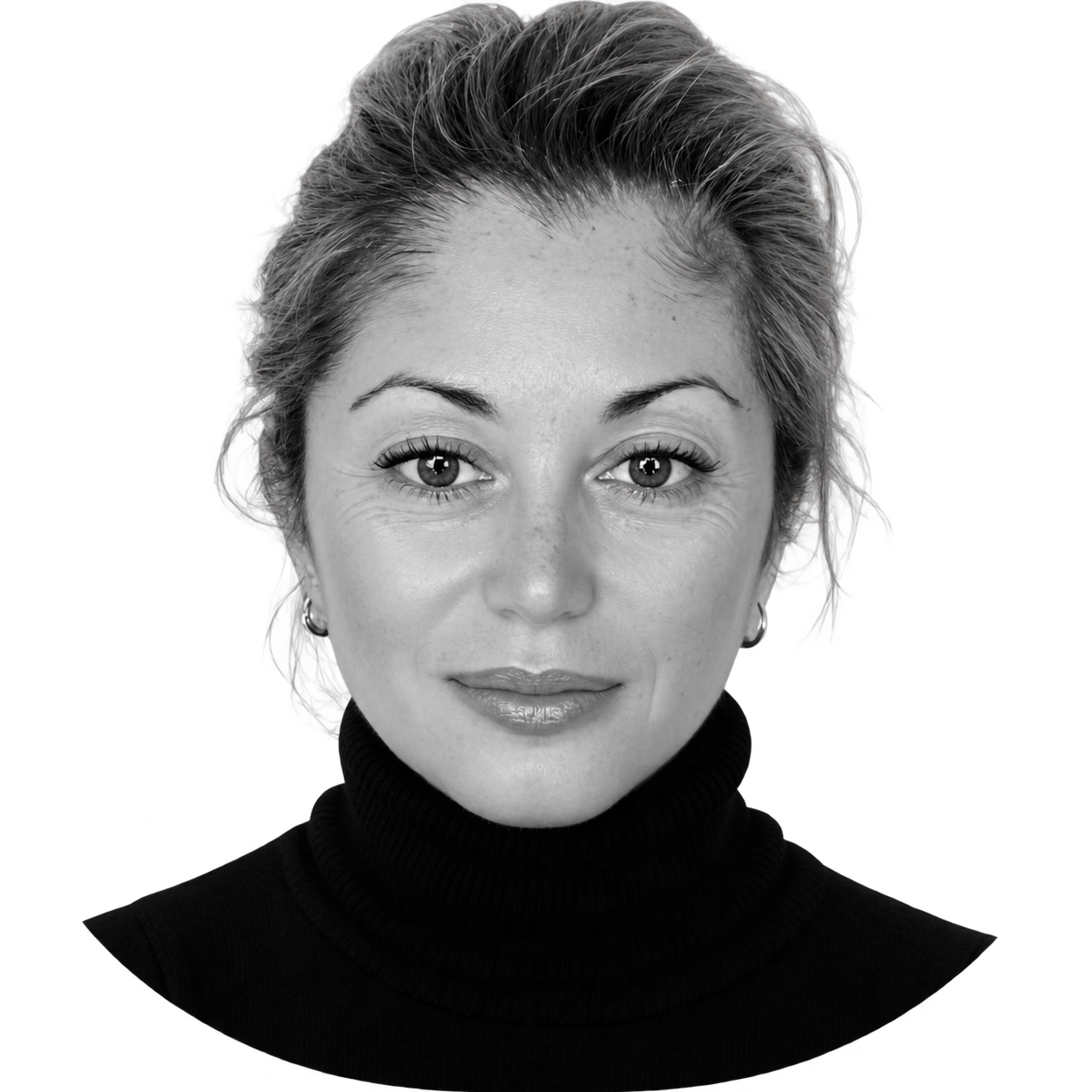
Janina White
Interlude. I left Myself
Extract from the Book "Invisible Woman"
Interlude. I Left Myself
I didn’t leave you — I left myself,
Put my courage on a shelf.
That night wasn’t death — it was escape,
A pause button shaped like a break.
On 17 September 2025, Laureano was taken to hospital after a suicide attempt, and I was left alone in a Ministry of Defence house at 81 Dawes Road, Uxbridge, with only my cat Mila for company.
The house stood in that strange belt of London not far from Northwood, close enough to military gravity to feel its pull, but far enough to be left in silence once the ambulances had gone. By the time the paramedics carried him out, evening had already thickened into darkness. All that remained in the living room was the weak light of a floor lamp, the artificial flame of the electric heater, and the enormous stillness that follows when life has been interrupted but not yet resumed.
I had been trying to drink tea, but I could not. I sat on the sofa and looked instead at the large painting above the heater: a sunset over the sea, far too calm for the room beneath it. I remember the glow of the electric fire, the dark floor, and the small plastic caps left behind from the needles the paramedics had used. They were still lying there, scattered and absurdly bright against the carpet. I had no strength to pick them up.
The house had become a shell. Laureano had survived, at least for the moment, but life had gone out of the room with him.
A little earlier, he had still been sitting on that same sofa. He looked at me and told me that he had taken the tablets. I saw the empty packets myself: two of Valium and three of paracetamol. I went straight into the kitchen and called for an ambulance, though in truth the emergency had begun long before that evening. Earlier that morning, I had already called the NHS because he had said that he was going to do it. I had asked them to make contact, to put him in touch with someone, to interrupt whatever spiral he had entered.
No one called back.
By the time I returned from the kitchen, he was unconscious on the sofa. I covered him with a blanket while I waited for the paramedics and stayed on the phone, answering questions, checking that he was still breathing, doing what I was told until help arrived.
From the moment he told me what he had done until the moment they took him away, I felt almost nothing. Not panic, not grief, not even fear. What I felt was a kind of inner freezing, as if my whole nervous system had stepped back and left only procedure behind. I watched his body as if from a great distance, though I was standing right beside it. He was bare from the waist up because the paramedics needed access for the monitors, and I remember being struck by how suddenly he seemed to have aged, as if something essential had already started to leave him.
The ambulance lights were one of the last vivid things I saw before the house fell silent. The second was Laureano’s body under the blanket, slack, depleted and strange. The third was what remained afterwards: the dark room, the standing lamp, the artificial fire in the heater, and me, frozen beyond the reach of pain.
What made the night more than private catastrophe, though I did not yet have the full language for it, was the fact that the house belonged to the Ministry of Defence.
I was sitting inside state housing, in the aftermath of a human collapse produced in no small part by military and institutional pressure, and yet I myself still had no confirmed administrative existence there at all. For more than two months, and by then nearly three, I had been trying to force my existence through MoD bureaucratic channels. In early July, Laureano and I had submitted an application explaining that he had separated from his wife, that I was now his new partner, that we were living together at that address, that we were trying to have a child, and that we were therefore seeking better housing conditions as a couple intending to expand the family. We had even notified them that I had brought my cat, Mila.
The application had gone first to his immediate commander within MARCOM, then into the Spanish command chain, and also to Pinnacle, the MoD’s housing management contractor. No one replied. We chased. There was still no reply.
So that night I was inhabiting a place in which I was physically present, intimately entangled, practically responsible, and yet still not properly acknowledged by any of the systems that governed it. I was visible enough to be affected by decisions, but not visible enough to be clearly recorded.
That was one of the first real shapes of what I would later come to call the condition of the invisible woman.
Much later, I would ask the British Ministry of Defence, NATO and the Spanish Ministry of Defence to confirm whether I had ever held any administrative status linked to Laureano Pastor at all, in any database, under any category. I received no meaningful answer. What I received instead, in other contexts, was something more troubling: consequences that appeared to be treated as derivative of those applied to him. My position seemed to exist when restrictions or implications flowed from him to me, but not in any way that granted clarity, recognition or standing.
Even then, although I did not yet know the architecture of it, I was already inside that paradox.
Laureano had attempted to escape nine days after learning that the investigation against him had ended in an administrative measure that removed the security clearance he needed in order to continue working at MARCOM. The decision, as he understood it, was connected to his relationships with me. Spanish command had ordered him back to Spain. Without me, I was not in the equation. With me, the life he had imagined no longer seemed to have a place to stand.
I do not think, even now, that he was trying to die in any final sense. What he wanted was escape, surrender, a pair of hands to fall into, some route out of responsibility and unbearable pressure.
In the end, he found one, though not that night. When I went to the hospital the following day, Laureano told me that Carlos Cordón, a colleague from MARCOM, had already been there to see him barely half an hour before I arrived. A week later, his wife flew in from Spain and persuaded him to return with her. That was how the matter was settled in human terms: he went back into the structure that knew how to receive him.
What stayed with me was not only that he was absorbed back into familiar command and family structures, but that I was left entirely outside every circle of concern. While he was in hospital, while I was still living in that house, while I visited him, and while the practical reality of what had happened was still unfolding around me, no one from any of the systems involved contacted me at all.
No one called. No one came. No one asked what I had seen, what I had done, how I had got him through those hours, or how I myself was managing after the event.
Had he died, I have no doubt that I might suddenly have become very visible indeed, perhaps as the subject of questions, suspicion or investigation into what assistance I had or had not provided. But because he lived, because his wife arrived, and because he agreed to go back, I could simply be ignored.
It was one of the clearest lessons of that period: I was visible enough for consequences, but not visible enough for care, inquiry or recognition.
A few days before his suicide attempt, Laureano had accidentally received a WhatsApp message not meant for him from a man called Mr Hernandez, who appeared to be helping from within the Spanish command structure. Hernandez wrote to someone else that Laureano had “not yet broken” and was “still conscious.” The cruelty of that message stayed with me. It suggested knowledge of his psychological fragility and of how close he was to the edge.
That, too, was in the house with me that night: not only silence, but the sense of method; not only absence, but the suspicion that absence itself had a structure. I did not yet have the words for the whole pattern. Those came later. I had no framework yet, no artificial intelligence to help me decipher the methods of three powerful institutions, and no channel through which to pour the emotion my body had frozen solid.
I had only the room, the heater, the painting of the sunset, the little plastic remains on the carpet, and the knowledge that I had been left inside both a private collapse and something much larger than private collapse.
At some point, still sitting on the sofa, I fell asleep. I do not remember deciding to. I do not remember thinking about the next day, or about consequences, or about what would happen to me in that house by morning. Tomorrow would come whether I prepared for it or not.
That night, all I could face was the deafening silence.
At the time, I thought I was spending one terrible evening in the wreckage of another person’s breakdown. I did not yet understand that I was already standing at the threshold of my own story: a story about invisibility, denial, administrative shadow, and the institutions that can alter a woman’s life without ever fully agreeing that she is there.
What the systems around us did not appear to calculate was that silence leaves records of its own. I would learn to read them.

☕ I want coffee.
So I have finally opened a Buy Me a Coffee page.
If you enjoy Invisible Woman blog and would like to support my writing, you can buy me one here:
https://buymeacoffee.com/jwhitelondv
I solemnly promise that the money will be spent exactly as advertised: on actual coffee — and possibly a bun. 🥐
And today's song "I left Myself"
